


Tingshas vs Singing Bowls: Which Sound Healing Tool Should You Use?
Learn the key differences between tingshas and singing bowls. Discover which Himalayan sound healing tool is best for meditation, space clearing, relaxation, and sound therapy.
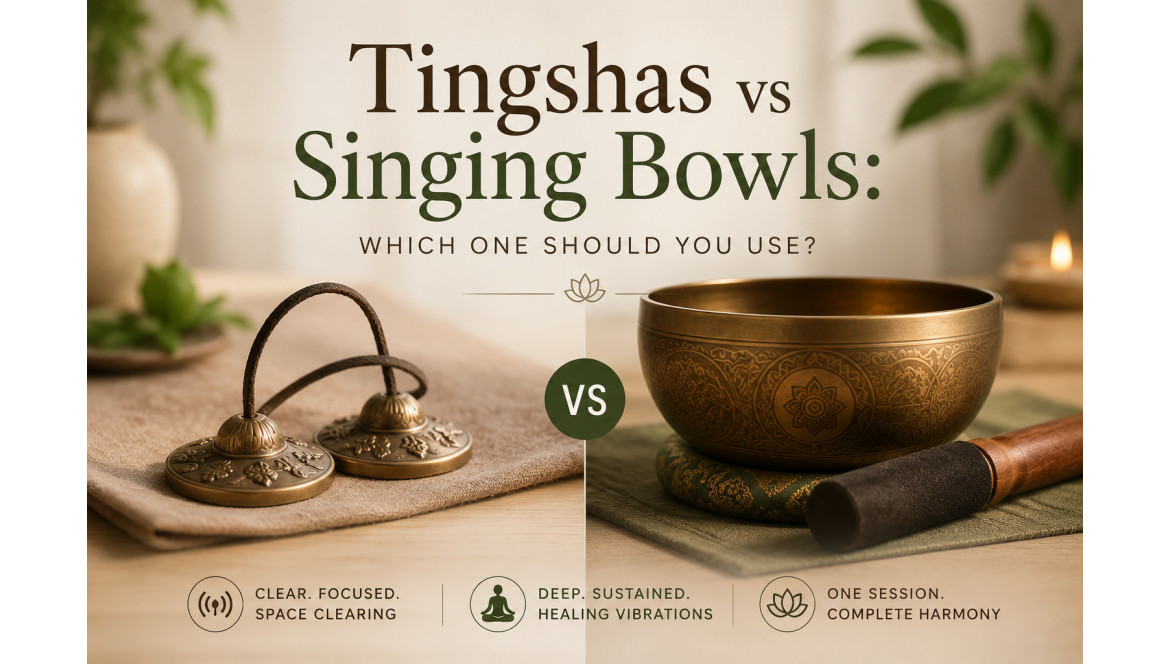
Tingshas vs Singing Bowls: Which One Should You Use?
Tingshas and singing bowls are two of the most widely used Himalayan sound healing tools, but they're built for very different jobs. One delivers a sharp, focused tone that snaps attention into place. The other delivers a deep, sustained vibration that carries a listener into stillness. Knowing which one fits your practice, or when to use both, makes a real difference in how effective your sessions are.
Quick Answer: Tingshas are small paired cymbals best suited to space clearing, signaling the start and end of a session, and short mindfulness breaks. Singing bowls are handcrafted resonant bowls best suited to deep meditation, sound baths, stress relief, and sleep support. Many practitioners use both together, tingshas to open and close a session, singing bowls for the main healing work in between.
What Are Tingshas?
Tingshas, sometimes called tingsha bells, are two small metal cymbals joined by a cord. When struck together, they produce a clear, high-pitched tone that rings out for roughly 3 to 10 seconds. Their defining traits are a sharp, focused sound, strong suitability for clearing stagnant energy from a space, ease of use even for complete beginners, and a natural fit for opening and closing rituals.
What Are Singing Bowls?
Singing bowls are handcrafted metal or crystal bowls that produce long, sustained vibrations when struck or played around the rim with a mallet. They're most commonly used for meditation and mindfulness, sound baths and broader sound healing work, chakra balancing, stress relief, and preparing the mind and body for sleep.
Quick Comparison
| Aspect | Tingshas | Singing Bowls |
|---|---|---|
| Sound | High-pitched, short | Deep, sustained |
| Duration | 3-10 seconds | Minutes or longer |
| Best For | Clearing, signaling | Meditation, healing |
| Ease of Use | Very easy | Requires practice |
| Cost | $30-$100 | $50-$500+ |
When to Use Tingshas
Space Clearing
Walk slowly around a room, ringing tingshas in the corners, to clear stagnant energy before beginning healing work.
Starting/Ending Sessions
Ring tingshas to clearly signal the beginning and end of a meditation or yoga class.
Short Breathwork
Tingshas are well suited to quick mindfulness breaks and short pranayama sessions in the 5 to 10 minute range.
Group Management
Use tingshas to capture a group's attention during class transitions.
When to Use Singing Bowls
Deep Meditation
Sustained vibrations help hold focus during longer 20 to 60 minute meditation sessions.
Sound Baths
Multiple bowls played together create an immersive, full-room healing experience.
Stress Relief
Long-lasting vibrations help calm the nervous system and ease anxiety.
Sleep Support
Listening to singing bowls before bed can quiet racing thoughts and ease the transition into rest.
Using Both Together
The most complete approach combines both tools in a structured flow: clear the space with tingshas for about 5 minutes, signal the opening with tingshas for 1 minute, move into the main healing work with singing bowls for 20 to 40 minutes, allow 5 minutes of silent integration, then close with tingshas for 1 minute. This sequence creates the clearing-healing-integration structure that professional sound healers rely on.
How to Choose
Choose Tingshas If:
You need quick mental clarity, you want to clear a space, you're managing a group, you want an affordable tool, or you're just starting out.
Choose Singing Bowls If:
You want deep meditation, you're offering sound baths, you want stress relief, you want an immersive healing experience, or you want support falling asleep.
Choose Both If:
You want a complete sound healing practice, or you're working as a sound healing practitioner and need tools for every stage of a session.
Frequently Asked Questions
Are tingshas better than singing bowls?
No. They're different tools built for different purposes. Tingshas excel at clearing and signaling, while singing bowls excel at deep healing and relaxation.
Can beginners use these?
Yes. Tingshas are very easy to pick up right away. Singing bowls take a bit more practice, but even beginners can produce genuinely therapeutic vibrations.
Can I use tingshas for meditation?
Yes, though they work best for short sessions of about 5 to 10 minutes. For longer meditation, singing bowls are the better choice.
Can I use singing bowls for sleep?
Yes. Listening for 10 to 20 minutes before bed can help calm the mind and prepare the body for rest.
What size singing bowl should I get?
A 7 to 8 inch bowl is a good starting point. It's easier to play and more affordable than larger sizes.
What's the difference between metal and crystal bowls?
Metal, or Himalayan/Tibetan, bowls are traditional, affordable, and versatile. Crystal bowls tend to have a purer tone and cost more. Both are therapeutic.
Can I use both tools together?
Yes. This is exactly how professional sound healers often structure sessions, using tingshas for opening and closing and singing bowls for the main healing work.
Final Thoughts
Tingshas bring sharp clarity, space clearing, and ritual structure. Singing bowls bring deep relaxation, emotional healing, and sustained meditation support. Choose based on your intention for the session, and for the most complete practice, consider using both together.
In Same Category
- Can You Place Singing Bowls on the Body? Safety and Best Practice
- Om Sajan Healing Center and Museum: Inside Kathmandu's Three-Floor Singing Bowl Sanctuary
- Handmade vs Machine-Made Singing Bowls: Key Differences
- Singing Bowl Mallet Guide: How to Choose the Right Mallet
- Why Do Tingshas Sound So Sharp and Clear?


Comments
No comment at this time!
Leave your comment