


Combine Singing Bowls, Gongs & Tingshas in One Sound Healing Session | Practitioner Guide
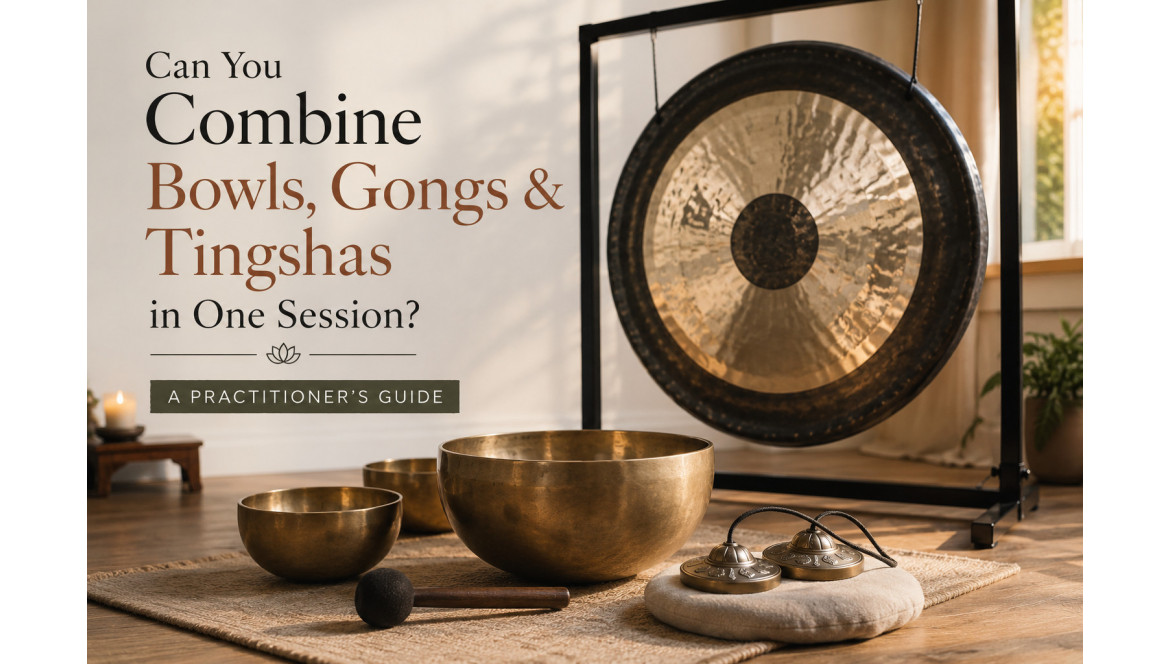
A practical guide to combining singing bowls, gongs and tingshas with gradual pacing, room-based selection, participant consent and sound safety.
How to Combine Singing Bowls, Gongs and Tingshas in One Session
Singing bowls, gongs and tingshas can be combined in a coherent wellness session, but there is no clinically validated sequence that every practitioner must follow. The structure below is a practical starting point based on acoustic contrast, gradual pacing, participant consent and manageable sound levels.
This guide is not a medical protocol. It is intended for trained or developing facilitators designing meditation, yoga or sound-bath sessions. For room layout, participant positioning and a complete session flow, see our group sound healing guide.
What Each Instrument Adds
Singing bowls
Metal bowls produce sustained tones with several audible partials. They work well for slow openings, repeated patterns and quieter sections because the facilitator can control each strike, rimmed tone and decay individually.
Gongs
Gongs can produce a wide dynamic and spectral range, from a soft shimmer to a dense, room-filling sound. Their role is not to “penetrate” or “clear” the body. Practically, they add scale, movement and intensity, so volume must be built gradually.
Tingshas
Tingshas create a bright, short attack followed by a sustained high tone. They can mark an opening, transition or closing, but their sound can feel sharp at close range. Use them sparingly and away from participants' ears.
Choose Instruments for the Room
Bowls
For a group, a set containing several larger bowls generally carries better than a collection of very small bowls. HSB's Himalayan Set of 7 Singing Bowls covers approximately 20 to 30 cm and is designed for deeper, more projecting tones.
When combining bowls, test them together in the actual room. Intervals can be a useful starting point, but there is no universal rule that every pair must be a third, fourth or fifth apart. Listen for excessive beating, unstable overtones and whether the set remains clear at the intended volume.
Gong and stand
For a group or outdoor-adjacent setting, HSB generally recommends a gong of at least about 60 cm, provided the room and facilitator can support it. The stand must be stable, rated for the gong and wide enough for free movement. Leave clear space around the instrument.
Mallets and accessories
Use a gong mallet suited to the instrument, bowl mallets that produce clean tones without excessive impact noise, and stable cushions for every bowl. Prepare a second, softer mallet when possible so intensity can be reduced without changing the whole session.
A Practical Session Arc
1. Explain the format
- Tell participants which instruments will be used and that the gong can become louder.
- Invite them to sit farther away, change position, open their eyes or leave if needed.
- Ask about sound sensitivity rather than promising a particular emotional result.
2. Begin with bowls
Use slow strikes with complete or near-complete decay between tones. This gives participants time to understand the room's sound level before the more complex gong enters.
3. Introduce the gong gradually
Start softly and build in short waves. Alternate gong passages with quieter bowl passages instead of maintaining constant maximum density. The gong should add contrast, not erase every other instrument.
4. Use tingshas only for clear transitions
One measured strike can mark a change. Repeated high-frequency strikes can become tiring and remove the contrast that makes tingshas useful.
5. Reduce intensity before the end
Retire the gong first, return to quieter bowls, then allow silence. A final tingsha strike is optional; a session can also close with a soft bowl or spoken guidance.
6. Support an ordinary return
Give participants time to move, sit up and orient to the room. Avoid telling them that dizziness, distress or disorientation is a necessary sign of healing.
Example 60-Minute Structure
| Time | Activity | Sound level |
|---|---|---|
| 0–5 min | Welcome, consent, sound-sensitivity guidance | Spoken voice |
| 5–15 min | Slow bowls with breath or body-awareness guidance | Quiet to moderate |
| 15–25 min | Bowls continue; gong enters in short, soft waves | Moderate |
| 25–40 min | Alternating gong and bowl sections with silence | Variable; avoid sustained maximum volume |
| 40–50 min | Gong retires; quieter bowl sequence | Gradually decreasing |
| 50–55 min | Silence and optional final tingsha or bowl | Quiet |
| 55–60 min | Orientation, movement and questions | Spoken voice |
The timings are adjustable. A smaller room, first-time group or sound-sensitive audience may need a shorter and quieter gong section.
Common Design Errors
Starting too loud
Sudden high volume can startle participants and makes it difficult to build a useful arc. Begin below the level you expect to use later.
Playing every instrument at once
Layering can be effective, but constant overlap reduces clarity. Give each instrument enough space to be heard and let sounds decay.
Treating silence as a problem
Silence helps listeners notice decay, breathing and room tone. It also gives the facilitator a chance to observe comfort without adding more stimulation.
Following the plan instead of the room
If people cover their ears, tense visibly or ask for less sound, reduce intensity. A prewritten sequence is never more important than participant feedback.
Using spiritual pressure
Do not tell participants they must surrender, release trauma or accept discomfort for the session to work. Offer optional interpretations and preserve the right to stop.
Sound-Safety Principles
- Keep gongs and tingshas at a respectful distance from ears.
- Control peak volume as well as average volume.
- Limit repeated sharp strikes and provide quieter intervals.
- Make ear protection or a more distant position acceptable without stigma.
- Check room reflections; a hard, small space can make the same instrument feel much louder.
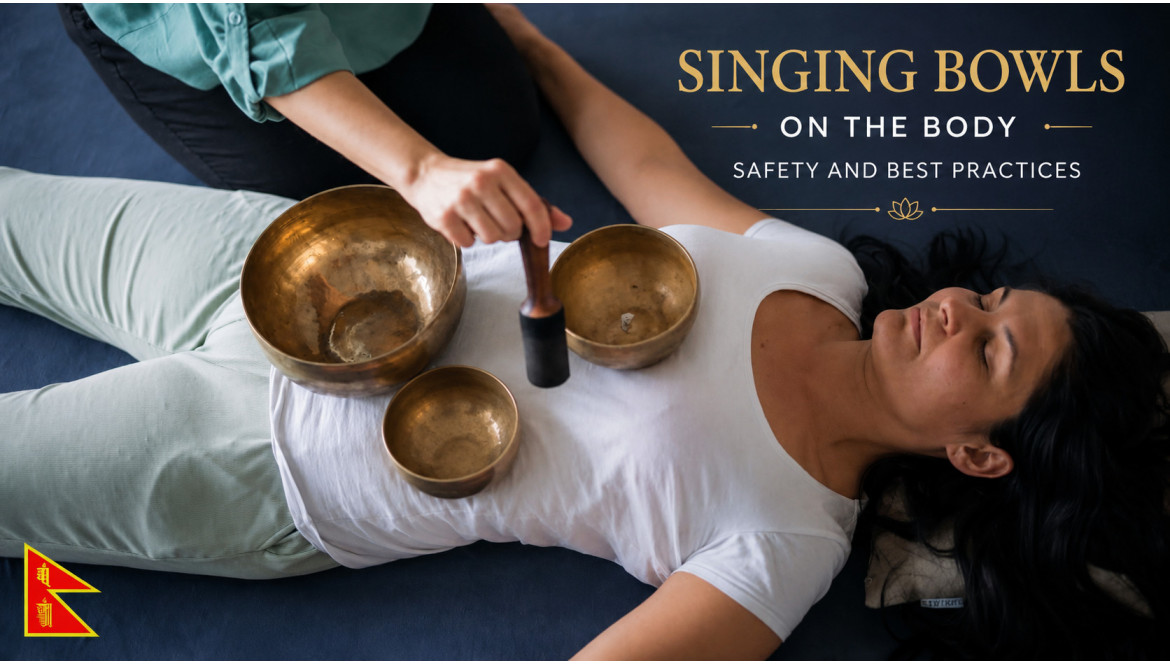
- Never place a bowl on a participant's body without specific training, informed consent and an appropriate protocol.
People with tinnitus, hyperacusis, sound-triggered migraine, hearing conditions or other medical concerns may need individual guidance. Refer medical questions to an appropriate healthcare professional rather than creating a universal exclusion list.
For trauma-sensitive groups, predictability and control are more useful than dramatic claims. Explain changes in advance, avoid surprise near the head and ensure participants can opt out.
What the Research Does and Does Not Support
No controlled trial has validated the exact “bowls, then gong, then tingshas” sequence described here. It is a practitioner-designed format.
A 2016 observational singing-bowl study reported short-term improvements in several self-rated mood measures. A 2023 randomized trial found lower self-reported anxiety after both singing-bowl sound and progressive muscle relaxation compared with waiting, with additional HRV and EEG changes in the bowl group.
A systematic review of clinical studies found promising but mixed results and emphasized study heterogeneity and insufficient data for several outcomes.
These findings can support modest language about relaxation. They do not prove that a combined gong-and-bowl session clears energy, treats a disease or produces a predictable neurological state.
Adapting the Format
Yoga studio
Use bowls during slower transitions or final relaxation, with a brief gong section if the room and class format allow. The sound should support the class rather than compete with instruction.
Spa or luxury hotel
A simple, repeatable sequence is easier for staff to deliver consistently. HSB can help choose a seven-bowl set, gong, stand and accessories according to room size, participant number and staff experience.
Sound-healing professional
Experienced practitioners may use a wider dynamic range or more complex bowl combinations, but should still document consent, sound-safety practices and how participants can signal discomfort.
Outdoor or large-group session
Use larger instruments with good projection, but do not compensate for open space by playing aggressively near the closest participants. Positioning and audience distance matter.
Frequently Asked Questions
Do I need all three instrument types?
No. A well-played bowl set can provide a complete session. Add a gong or tingshas only when their contrast serves the format.
Which instrument should open the session?
Bowls are often the easiest starting point because their level can be introduced gradually. A soft gong or single tingsha can also work if explained and played carefully.
What gong size works for a group?
HSB commonly considers 60 cm or larger for group use, then adjusts for room size, audience distance and facilitator skill.
Can HSB help design an equipment set?
Yes. Review our service for sound-healing professionals or contact HSB on WhatsApp for a 30-minute presentation and first recommendation.
Conclusion
The strongest combined session is not the loudest or the most complex. It uses clear acoustic roles, gradual intensity, silence, observation and participant choice. Treat the structure as a flexible design, not a medical recipe.
This article is for general information and does not provide medical advice.
In Same Category
- Can You Place Singing Bowls on the Body? Safety and Best Practice
- Om Sajan Healing Center and Museum: Inside Kathmandu's Three-Floor Singing Bowl Sanctuary
- What Is Sound Healing? Traditions, Sound Baths & Research
- Tingshas vs Singing Bowls: Which Sound Healing Tool Should You Use?
- Handmade vs Machine-Made Singing Bowls: Key Differences


Comments
No comment at this time!
Leave your comment