

What Is Sound Healing? Traditions, Sound Baths & Research
A clear guide to religious sound practices, modern sound baths and clinical research, with culturally accurate history and evidence-based claims.
What “Sound Healing” Means: Traditions, Modern Sound Baths and Research
“Sound healing” is an umbrella term, not one single historical practice or scientifically defined treatment. It can refer to religious and contemplative uses of sound, contemporary wellness sessions, music therapy, vibroacoustic research or commercial sound baths. Clear language matters because these activities have different histories, aims and evidence.
Three Contexts That Should Not Be Confused
1. Named contemplative and religious sound practices
South Asian traditions include mantra recitation, devotional singing, kirtan and approaches often grouped under Nada Yoga. Within their own philosophical settings, sound may be used for concentration, devotion, ritual or spiritual transformation.
These traditions are not simply early versions of a modern commercial sound bath. Their meanings depend on language, lineage, texts, teachers and community practice. HSB therefore avoids treating “Eastern sound healing” as one uniform system.
2. Contemporary wellness sound baths
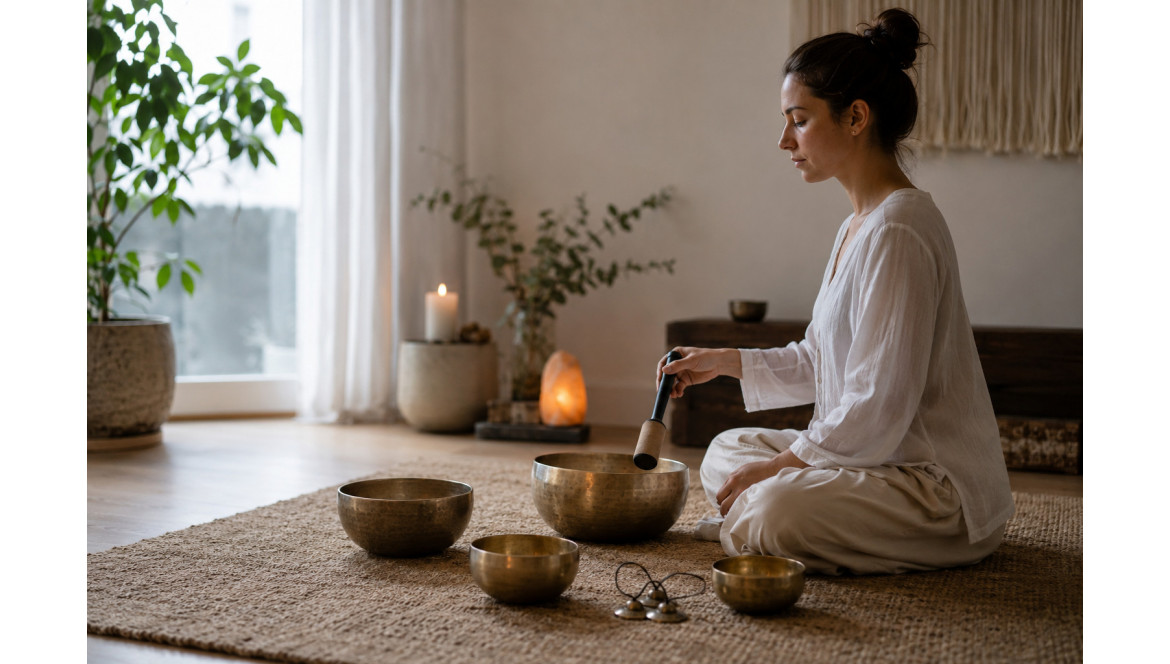
A modern sound bath is usually a guided group or individual listening session using instruments such as singing bowls, gongs, chimes or voice. Participants commonly lie or sit down while a facilitator creates a gradual sequence of sound and silence.
The aims are generally relaxation, mindful attention and a pleasant shared experience. This format is best described as a contemporary wellness practice, even when it includes instruments or ideas drawn from older cultures.
3. Clinical and research uses of sound
Researchers study many different sound interventions: music therapy delivered by qualified professionals, recorded music, vibration applied through equipment, singing-bowl listening and other protocols. Results from one category should not automatically be transferred to another.
“Sound therapy” can also be a regulated or professionally defined term in some contexts. A wellness facilitator should not imply the qualifications of a licensed clinician or music therapist.
Where Singing Bowls Fit
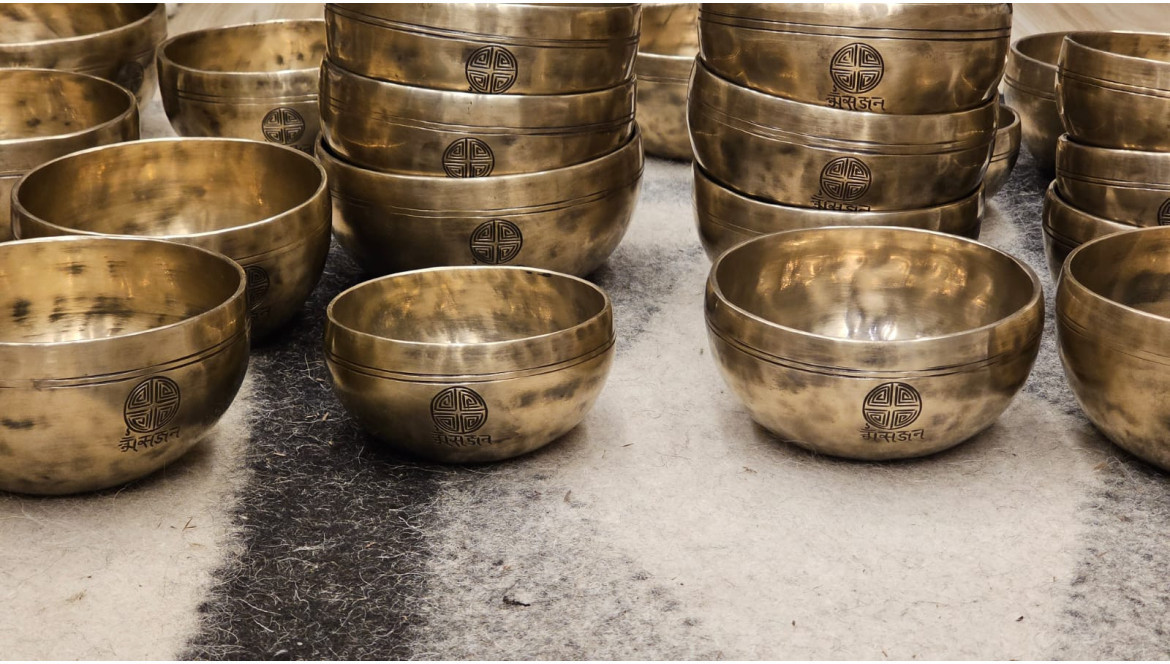
Metal singing bowls are strongly associated with the Himalayan commercial and craft networks of Nepal and neighbouring regions. They are now used internationally for meditation, personal practice, yoga, wellness sessions and performance.
Historical evidence does not establish that the modern passive group sound-bath format was a standard Tibetan monastic therapy practised for centuries. This does not reduce the value of the instrument; it separates present-day use from an origin story that is often repeated without documentation.
It is also more accurate to say “Himalayan metal singing bowl” when discussing the instrument broadly. “Tibetan singing bowl” remains a common search and market term, but it should not be used as proof of a specific Tibetan ritual history.
What Research on Singing-Bowl Sessions Suggests
A 2016 observational study of 62 participants reported lower self-rated tension, anger, fatigue and depressed mood immediately after a sound meditation. Because the study had no control group, it cannot isolate the effect of the bowls from rest, expectation, setting or facilitator contact.
A 2023 randomized trial of 50 adults with high state anxiety compared a singing-bowl session with progressive muscle relaxation and a waiting list. Both active interventions reduced self-reported anxiety compared with waiting; the bowl group also showed changes in heart-rate variability and EEG measures during the session.
Recent systematic reviews found promising results for some outcomes, but also small samples, different protocols and low-to-moderate certainty for much of the evidence. See the reviews in Integrative Medicine Research and Healthcare.
The evidence supports cautious claims about possible short-term relaxation or anxiety reduction for some participants. It does not support saying that bowls cure disease, clear a specific organ, release trauma automatically or produce the same effect in everyone.
How Might a Sound Session Feel Relaxing?
Several ordinary factors may contribute:
- Focused listening: sustained sound can give attention a simple anchor.
- Reduced stimulation: lying still in a quiet, structured setting can itself support rest.
- Breathing and pacing: facilitators often use slow instructions and long pauses.
- Expectation and context: the room, group, practitioner and participant's expectations can affect perceived outcomes.
- Acoustic characteristics: volume, timbre, repetition and beating patterns influence how the sound is perceived.
Some experiments have measured EEG or heart-rate-variability changes during particular bowl protocols. Those observations are not proof that every singing bowl “entrains” the brain or directly stimulates the vagus nerve in a predictable therapeutic way.
Spiritual and Energetic Language
Chakras, prana, nadis, sacred sound and energetic clearing belong to spiritual or practitioner frameworks. They can be discussed respectfully when their context is named. They should not be presented as anatomical structures or medical mechanisms established by clinical research.
The same distinction applies to note and frequency claims. A bowl can be measured acoustically, and HSB can select a fundamental note within an agreed tolerance. That technical measurement does not prove that one frequency treats one organ, emotion or chakra.
A Clear Comparison
| Context | Typical aim | How claims should be framed |
|---|---|---|
| Mantra, chanting, kirtan, Nada Yoga and other named traditions | Devotion, concentration, contemplative or spiritual practice | Explain the specific tradition and avoid collapsing many cultures into one “Eastern” method |
| Contemporary sound bath | Relaxation, mindful listening, group wellness experience | Use wellness language and describe the actual session format |
| Clinical or experimental sound intervention | Test a defined outcome under a protocol | Name the population, method, comparator and limitations of the study |
| Energy or chakra practice | Symbolic, spiritual or practitioner-defined balance | Identify it as a belief or practice framework, not a proven medical mechanism |
Claims That Are Reasonable
- Many people use singing bowls and gongs for meditation and relaxation.
- Small studies have reported short-term changes in self-rated anxiety, mood, heart-rate variability or EEG measures.
- Responses vary, and some people feel neutral or uncomfortable.
- Volume, distance, duration, facilitator skill and context matter.
- More rigorous, larger and better-controlled studies are needed.
Claims That Need Qualification or Removal
- “Tibetan monks have used these bowls as a medical therapy for thousands of years.”
- “This exact frequency heals a named organ or condition.”
- “A sound bath activates the parasympathetic nervous system in everyone.”
- “Emotional distress during a session proves that trauma is being released.”
- “Scientific evidence confirms all chakra or energetic claims.”
Frequently Asked Questions
Is sound healing one ancient tradition?
No. The term now covers several different religious, contemplative, wellness and research contexts.
Are modern sound baths traditional Tibetan rituals?
The modern passive group format is better described as a contemporary wellness practice. Singing bowls may have older craft and ritual associations, but that does not establish the current format as an ancient monastic therapy.
Is there scientific evidence for singing-bowl sessions?
There is early clinical and observational evidence for some short-term outcomes. Reviews also emphasize methodological limits and low-to-moderate certainty.
Can sound healing replace medical or psychological treatment?
No. It may be used as a complementary wellness activity, but it should not replace qualified diagnosis or treatment.
Can HSB select bowls by musical note?
Yes. HSB measures a bowl's fundamental frequency for eligible note-selected products. Musical selection is an acoustic service, not a promise of a specific medical effect.
Conclusion
The clearest approach is to name the practice being discussed. Mantra is not the same as a commercial sound bath; a wellness session is not the same as music therapy; a measured note is not a medical prescription.
Accurate distinctions make the field more credible and allow people to appreciate both cultural traditions and contemporary research without inventing history or overstating evidence.
This article is for general information and does not provide medical advice.
About Sajan Shakya
Sajan Shakya is the HSB contact responsible for customer support, digital development and international coordination. He comes from a Newar family of singing-bowl makers and has a background in information technology. Through Healing Singing Bowls and its online shop, he helped open the family workshop to international customers. Learn more about the HSB team and the HSB workshop in Kathmandu Valley.
In Same Category
- Can You Place Singing Bowls on the Body? Safety and Best Practice
- Om Sajan Healing Center and Museum: Inside Kathmandu's Three-Floor Singing Bowl Sanctuary
- Tingshas vs Singing Bowls: Which Sound Healing Tool Should You Use?
- Handmade vs Machine-Made Singing Bowls: Key Differences
- Singing Bowl Mallet Guide: How to Choose the Right Mallet


Comments
No comment at this time!
Leave your comment