

Om Sajan Healing Center and Museum: Inside Kathmandu's Three-Floor Singing Bowl Sanctuary
Discover Om Sajan Healing Center and Museum in Thamel, Kathmandu—a three-floor destination combining a singing bowl store, museum-style collection, and dedicated sound healing hall. Explore its handmade singing bowls, gongs, healing sessions, training programs, and what to expect when visiting.
Om Sajan Healing Center and Museum: Inside Kathmandu's Four-Floor Singing Bowl Sanctuary
Located in Thamel, Kathmandu, the Om Sajan Healing Center and Museum is one of the few dedicated singing bowl facilities in Nepal that combines a store, a museum, and a healing center under one roof. The center sits directly across from the singing bowl shop run by Sajan Thapaliya, the founder of Om Singing Bowls and Healing Hub, a government-registered sound healing center. While the shop is well known among visitors, the four-floor building opposite it remains lesser known, despite housing an extensive collection of singing bowls, gongs, and a dedicated healing hall.
What Is the Om Sajan Healing Center and Museum?
The building serves four distinct purposes:
- A store, with hundreds of singing bowls available for purchase
- A gong floor, a dedicated space for gongs of all sizes
- A small museum, with rare, antique, and unusual pieces on display
- A healing center, a large, quiet hall for sound therapy and group sessions
Unlike most singing bowl shops in Kathmandu, which occupy a single room, this center dedicates each floor to a specific function. This separation allows visitors to shop without disturbing ongoing healing sessions, and ensures that sound therapy takes place in a calm, undisturbed environment.
The center is run by Sajan Thapaliya, who has worked with singing bowls, gongs, and tingsha for many years. Beyond playing these instruments, he oversees their production, paying close attention to the metal alloy used in each bowl to ensure the quality of tone.
Ground Floor: The Store
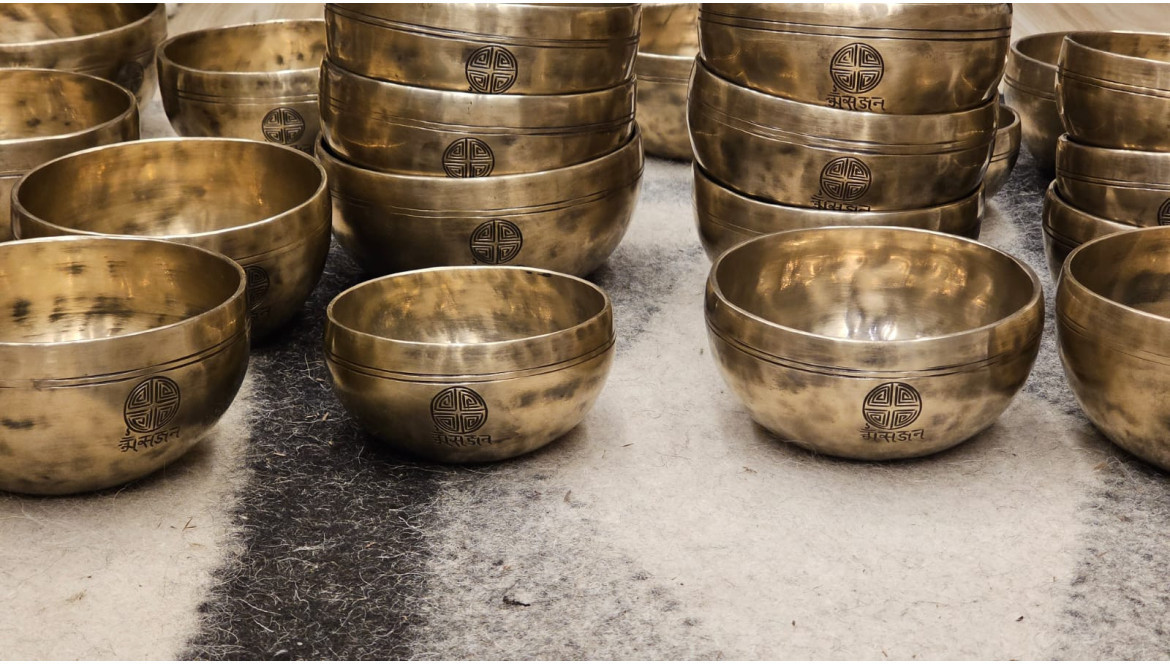
The ground floor is dedicated to retail. It stocks a wide range of singing bowls, from small palm-sized bowls to large two-handed pieces.
A key feature of this floor is that all instruments can be tested before purchase. Since two bowls that appear identical can produce very different sounds, testing is considered essential. Visitors are given time to play and compare without pressure.
First Floor: The Gong Floor
The first floor is dedicated entirely to gongs. Gongs of all sizes are displayed along the walls, from smaller decorative pieces to large ceremonial instruments. As with the ground floor, all instruments can be tested before purchase. The gong's wide, physically felt wall of sound distinguishes it from the singing bowl experience, with vibrations perceptible not just audibly but physically, in the floor and in the body.
Second Floor: The Singing Bowl Museum
The second floor contains additional stock alongside a curated museum-style display. The pieces on display are not standard retail items. They include antique bowls with worn surfaces, hand-hammered marks, and aged patina, as well as newer pieces notable for unusual sizes, engravings, or exceptional tone.
This floor provides context for understanding the instrument beyond its commercial use, drawing attention to craftsmanship, materials, and the history behind Himalayan metalwork.
Third Floor: The Healing Hall
The third floor houses a large open hall designed specifically for sound healing sessions. It features warm flooring, cushions and mats, singing bowls arranged on the ground, and a large gong as the centerpiece.
Acoustics and Quiet
The building sits approximately 20 metres back from the street, and the healing hall occupies the third floor. This combination of distance and height effectively blocks the noise of Thamel from reaching the hall, an important practical detail, since sound healing relies on the ability to hear tones rise, spread, and fade without interruption.
The Gong
The large gong in the hall produces a wide, physically felt wall of sound rather than a single clear note. This distinguishes the gong experience from that of a singing bowl, as the vibrations are perceptible not just audibly but physically, in the floor and in the body.
Group Capacity
The hall is large enough to accommodate group sessions comfortably, with space for mattresses laid out in rows. This makes it suitable for:
- Couples and families
- Yoga retreat groups
- Corporate wellness or team days
- Students on multi-day training courses
- Travelers who prefer shared sessions
Services Offered
Individual sound therapy. One-on-one sessions with bowls placed on or around the body, typically lasting around an hour.
Group sound baths. Participants lie down while bowls and gongs are played. No prior experience is required.
Training and certification courses. Multi-day programmes in singing bowl, gong, and tingsha therapy. Students attend from India, China, Europe, and the United States. Courses are generally considered well-structured and competitively priced compared to other options in Nepal.
Instrument sales. Bowls, gongs, tingsha, mallets, and cushions are available. The center also produces its own line of handmade bowls made from a seven-metal alloy, designed for working therapists.
A Note on Sound Healing
Sound healing is a relaxation and wellbeing practice. Available evidence supports its use for calming the nervous system, reducing stress, quieting mental activity, and improving sleep. It is not a substitute for medical treatment, and the center does not position it as one.
Location and Contact
| Name | Om Singing Bowls and Healing Hub |
|---|---|
| Area | Z-Street, Thamel, Kathmandu, Nepal |
| Landmark | Next to Hotel Ramada Encore |
| Founder | Sajan Thapaliya |
| Phone / WhatsApp | +977 9849380480 |
| omsingingbowlhealing@gmail.com | |
| Website | omsingingbowlhealing.com |
| Status | Government-registered healing center |
Frequently Asked Questions
Is there a real museum inside?
There is a museum-style display on the second floor featuring rare, antique, and unusual pieces. It is a curated section within the building rather than a separately ticketed museum.
Is prior experience needed for a session?
No. Most first-time participants simply lie down and listen.
How long do sessions last?
Individual sessions run approximately one hour. Group sessions and gong baths vary in length. Training courses span several days.
Is it suitable for children?
Generally yes, though it is advisable to confirm when booking. The large gong produces significant volume and may be startling for young children.
Can singing bowls be taken on a plane?
Yes. Bowls travel without issue. Larger pieces are heavy, so baggage allowances should be checked in advance. The shop can advise on packing and international shipping.
How much does it cost?
Prices vary by service and are updated periodically. Current rates are available by contacting the center directly.
When is the best time to visit?
Spring and autumn offer the most comfortable weather in Kathmandu. However, since the healing hall is indoors and climate-controlled, the center operates effectively year-round.
In Same Category
- Can You Place Singing Bowls on the Body? Safety and Best Practice
- What Is Sound Healing? Traditions, Sound Baths & Research
- Tingshas vs Singing Bowls: Which Sound Healing Tool Should You Use?
- Handmade vs Machine-Made Singing Bowls: Key Differences
- Singing Bowl Mallet Guide: How to Choose the Right Mallet


Comments
No comment at this time!
Leave your comment