


Nepal's Gong Industry Is Quietly Moving to China
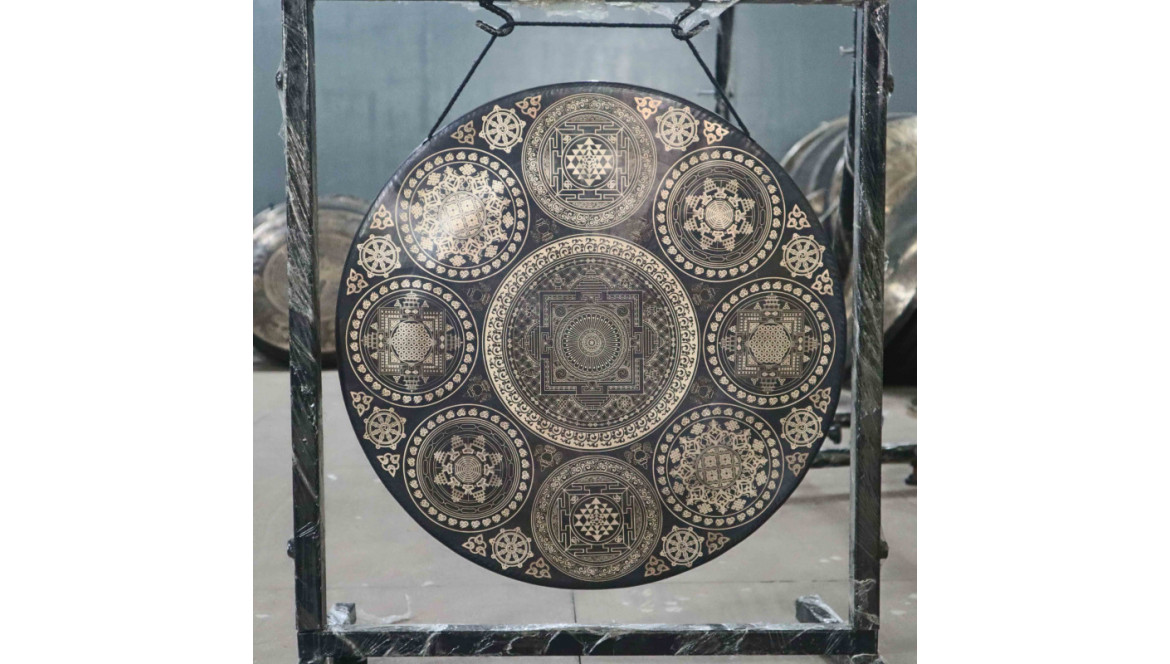
This article explores the changing origins of gongs sold in Nepal, examining how Chinese-made gong bodies have increasingly replaced locally made and Burmese gongs. It looks at the reasons behind this shift, the role of Kathmandu workshops in carving and finishing, the impact on traditional gong-making skills, and what buyers can ask to determine where a gong was actually made.
Ask where a gong sold from Nepal actually came from, and the honest answer, more often than not, is China. Not the carving on top. Not the finishing touches. The gong itself, the cast and hammered metal body that gives it its tone.
Nepal's Department of Customs does publish annual foreign trade statistics for metal products, but the figures are grouped at the commodity level, not by item, so they don't isolate gongs from the wider category of base-metal goods. Chinese-made gong bodies, produced faster and cheaper than most Nepali workshops can match, now form the base of many gongs sold from Nepal, including some still marketed as handmade, Burmese, or Himalayan.
Where These Gongs Used to Come From
For years, the standard supply route looked different. Raw or semi-finished gongs, often in the bossed, nipple-style shape associated with Burma gongs, came from Myanmar, a country with its own centuries-old tradition of hand-hammered bronze gong making. From there, workshops in Kathmandu would finish, decorate, and sell them on, sometimes under labels like Burma gong or Nepal Burma gong.
That route is the one now being replaced.
Why China Became Competitive
It would be easy to assume China's position here comes purely from automation undercutting real craftsmanship, but that's not the full picture. Wuhan, in Hubei province, has been associated with hand-hammered bronze gongs and cymbals for centuries, a reputation still referenced today by international cymbal and gong brands built on that legacy. That heritage sits alongside a much larger modern manufacturing base elsewhere in the country, where hammering techniques are combined with modern equipment, larger facilities, and established export supply chains to produce gongs in much greater volume while keeping tone quality consistent.
A real hammering tradition paired with genuine industrial-scale capacity is a difficult combination for smaller Burmese or Nepali workshops to compete with on price alone.
What's Left of Local Gong Making in Kathmandu
Producing a gong entirely in-house, without sourcing the base metal from China, comes down to price. A hand-formed gong made from scratch in Nepal takes far longer to produce than one built around an imported Chinese blank, and that time difference shows up directly in what a workshop can charge.
Fewer gongs now start as raw metal hammered from the ground up locally. More start as a finished or semi-finished body imported from China.
The Part That's Still Made in Kathmandu
What remains local, for the most part, is the decoration. The carving that gives a gong its mandala, mantra, or deity motifs is often still done in Kathmandu, but increasingly with a laser rather than by hand, the same shift already reshaping how singing bowls are carved.
A common pattern now looks like this: a gong body made in China, finished and laser-carved in Kathmandu, then sold as a Nepali or Himalayan product.
Does This Affect the Sound?
Not necessarily, and it's worth being fair about this. Chinese gong manufacturing, particularly in regions with a long hammering tradition, can produce genuinely resonant, well-tuned instruments. The concern isn't that Chinese-made gongs sound bad. It's that a gong marketed as handmade in Nepal, or as an authentic Burma gong, may have very little to do with either place beyond where it was decorated and sold.
What This Means for Nepal's Handicraft Industry
This is the harder part. Full gong hammering, the skill of shaping a large bronze disc into a tuned instrument entirely by hand, isn't something most workshops get much chance to practice anymore, since much of what they now handle arrives already formed. That's a different kind of pressure than the one facing singing bowl carvers or hammerers, where at least part of the traditional process still survives locally. For gongs, the core hammering skill risks fading simply from lack of use, even among craftsmen who would otherwise be capable of it.
How to Know Where Your Gong Actually Comes From
- Ask directly. Where was the gong body made, and where was it decorated? These are two separate questions with two separate answers.
- Don't assume "Burma gong" means Burmese. The name has become a style descriptor as much as a place of origin.
- Ask about hammering marks. A fully hand-hammered body tends to show slight surface irregularity that a machine-formed one usually won't.
FAQ
Are gongs sold from Nepal actually made in Nepal?
Often, not entirely. Many workshops now source the gong body from China and handle decoration and finishing locally.
What is a Burma gong?
A Burma gong, also called a Burmese or temple gong, is a bossed, hand-hammered bronze gong traditionally associated with Myanmar. The term is now used broadly in the sound healing trade to describe the style, not always the country of origin.
Are Chinese-made gongs lower quality than Burmese or Nepali ones?
Not inherently. Regions of China with a long gong and cymbal-making history can produce genuinely well-tuned, resonant instruments. The real issue is accurate labeling, not sound quality.
Why did gong manufacturing shift toward China?
Mainly speed and price. Chinese producers can turn gongs around faster and more cheaply than most Nepali or Burmese workshops, while maintaining a quality many buyers find acceptable.
Final Thoughts
The singing bowl trade still has hand hammering surviving at its core, even as the steps around it change. Gongs are a step further along that same road, and the shift happened fast. Gongs sold from Nepal used to come from two main sources: some made locally in Kathmandu, others imported from Burma, long known for its own bronze gong tradition. In a short span of time, Chinese-made gong bodies moved in and displaced both at once, cutting into the Burma imports and a real share of local production. For a number of workshops, the hammering itself has already moved elsewhere, leaving Kathmandu with carving and finishing work rather than the full craft. Whether that's a permanent shift or a phase the industry works through likely depends on whether buyers start asking where the gong actually came from, not just where it was sold.
In Same Category
- How Size, Thickness, and Form Change the Sound of a Singing Bowl
- Do Singing Bowls Really Contain 7 Metals? The Truth Explained Simply
- The Laser Revolution: How Machine Carving Is Quietly Replacing Nepal's Hand-Carved Singing Bowl Tradition
- Hand-Hammered Singing Bowls: The Step Machines Replaced
- Not Every Singing Bowl Comes From Nepal




Comments
No comment at this time!
Leave your comment