


Hand-Hammered Singing Bowls: The Step Machines Replaced
The words "hand-hammered" and "handmade" carry a lot of weight in the singing bowl trade, but they say nothing about how the metal was prepared before the hammering began. In Kathmandu Valley workshops today, the alloy is still melted and mixed by hand, and the bowl is still formed by a hammering team working a mould in real time. What's changed is the starting point: instead of a thick cast blank, the metal is rolled into an even sheet and cut into uniform discs. This piece looks at why that shift happened, how it cuts hammering time to roughly ten to fifteen minutes, and whether the resulting bowl still deserves the label.
"Hand-hammered," "handmade," and "handcrafted" are some of the most trusted words in the singing bowl trade. They suggest a bowl shaped entirely by a person, start to finish, with nothing mechanical in between. These are the same bowls often labeled and sold internationally as Tibetan or Himalayan singing bowls, even though the workshops making them today are Nepalese, based in the Kathmandu Valley. A closer look at how these bowls are actually made today, from raw alloy to finished form, shows that the assumption behind those words is only partly true anymore.
The hammering itself is still done by hand, by a team working in rhythm around the bowl. What's changed is everything that happens before the first hammer strike, and that change is what makes today's hand-hammered singing bowls possible to produce so much faster than before, without necessarily making them any less handmade in the way that matters most.
How a Singing Bowl Was Traditionally Shaped
In the traditional method, the alloy is melted and mixed by hand, then poured or cast into a raw, thick blank of metal. From that point, the entire shaping process falls to the hammer. A carver, or in this case a hammerer, has to beat that uneven, thick blank into both a bowl-like form and a consistent wall thickness at the same time. In metalworking terms, this hammering process is itself a form of forging, which is why some sellers use the term forged singing bowl instead of hand-hammered.
That second part, getting the metal to an even thickness all the way around, has always been the real challenge of hand hammering. Too thick in one spot and thin in another, and the bowl's tone and durability both suffer. Traditionally, solving that problem by hand, blow by blow, is what made this stage of the work so slow and so dependent on real skill. This is the traditional singing bowl making process most descriptions of a truly handmade singing bowl are still referring to.
The Step Most Buyers Never Hear About
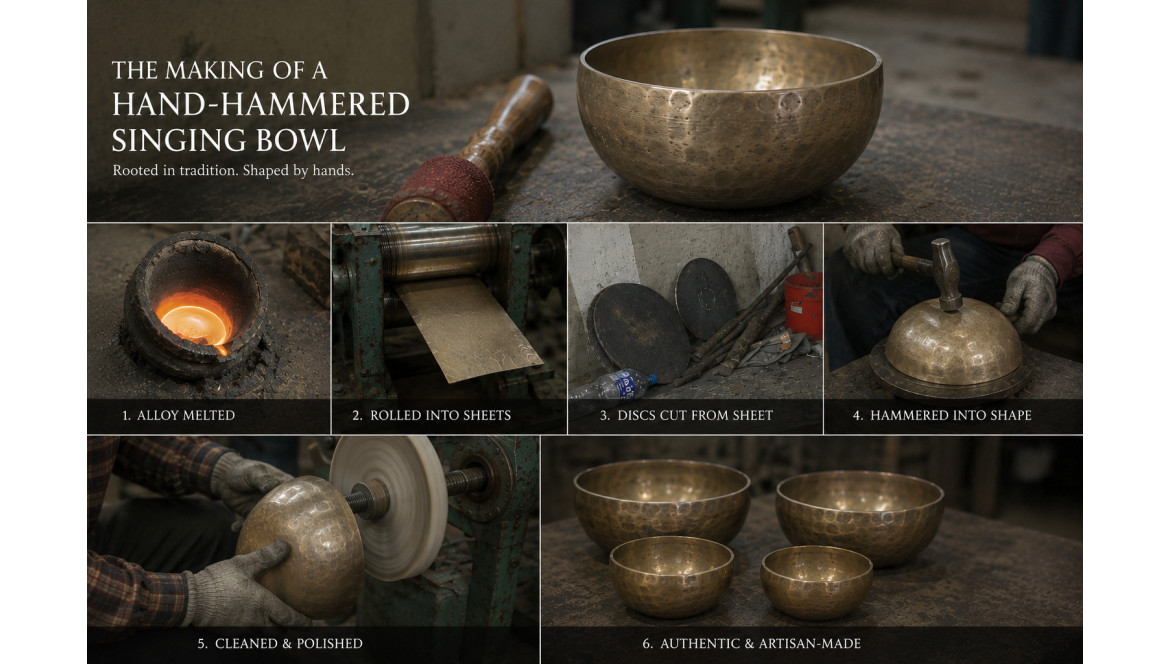
In a number of workshops across the Kathmandu Valley, that starting point looks different now. The alloy is still melted and hand-mixed the traditional way. But once it's hot, instead of being cast directly into a thick raw blank, it's passed through a rolling machine that presses it out into a large sheet of metal with a consistent, even thickness across the whole sheet.
From that sheet, workers cut out individual discs sized for each bowl. The exact thickness varies by bowl and workshop and isn't something to treat as a fixed industry standard, but the principle holds: the metal disc that reaches the hammerers is already uniform before a single hammer blow is struck. It's a small change, but it reflects a broader shift in singing bowl manufacturing across the valley, even for bowls that are still finished entirely by hand.
Why This Makes the Hammering So Much Faster
This is where the time savings actually come from. Because the disc starts out even, the hammering team no longer has to fight to correct thickness while also shaping the bowl. They're only solving one problem instead of two: turning a flat, uniform disc into a bowl-shaped form.
In workshops using this method, a hammering team can take a disc from flat to basic bowl shape in roughly ten to fifteen minutes, working together on a mould. Exact times vary by workshop, team size, and bowl size, but it gives a real sense of how much of the traditional challenge disappears once the metal arrives pre-leveled.
Once the bowl holds its form, there's typically a final step to clean off dirt, oxidation, and staining left from the hammering and rolling process. Machine polishing has handled this step across the industry for decades, and it has largely replaced hand polishing at this stage since a buffing wheel can clean and shine a bowl far faster than doing it by hand.
Is It Still a "Hand-Hammered" Bowl?
This is worth sitting with honestly, because it's not as simple as the laser carving story, where a machine replaces a human skill outright. Here, the part that actually defines a hand-hammered bowl, the hammering itself, is still done by human hands, working a mould, in real time. What's been mechanized is the preparation before that step and the cleanup after it.
So the label "hand-hammered" isn't false. But it's also doing more work than most buyers realize, since it says nothing about how the metal was prepared before the hammering started. A bowl made from a machine-rolled disc and a bowl made from a hand-cast blank can both fairly be called hand-hammered, even though one of them represents meaningfully less total manual labor than the other.
Why Manufacturers Are Making This Shift
From a singing bowl manufacturing standpoint, the appeal is straightforward. Rolling the metal to a consistent thickness removes the hardest, slowest part of traditional hammering, so workshops can scale up singing bowl production without cutting the hand-hammering step out altogether. That consistency also tends to reduce the number of bowls lost to cracking or uneven walls during hammering, which matters for a small workshop's margins.
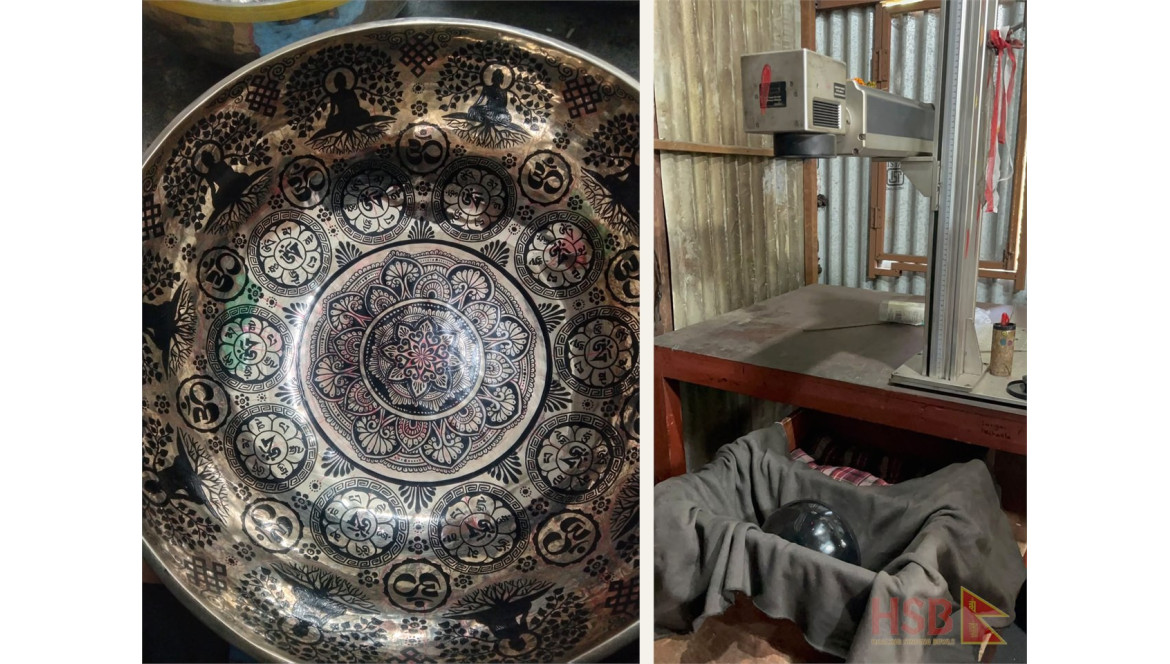
For buyers, the practical effect is a wider supply of authentically hand-formed bowls at a more accessible price than the fully traditional process would allow, without the ethical grey area that surrounds something like laser-carved decoration being sold as hand-carved.
What This Means If You're Buying a Hand-Hammered Bowl
- The core craft is intact. The forming of the bowl, the part that most affects its tone and character, is still done by a hammer in human hands, which is what makes it a genuine hand-hammered singing bowl and not a mould-injected copy.
- "Hand-hammered" doesn't mean zero machinery. It's worth asking a seller how the metal blank was prepared, not just whether the bowl was hammered.
- Faster production isn't automatically a red flag. A shorter hammering time can reflect better-prepared material rather than lower-quality work.
- The finishing step matters less than the forming step. A machine-polished bowl that was hand-hammered into shape is a different thing entirely from a fully machine-formed bowl.
Final Thoughts
Not every change in Nepal's singing bowl trade is a story about a craft disappearing. This one is closer to a craft adapting to keep up with demand: as the global market for singing bowls has grown, workshops have needed to produce faster, and what's been streamlined is the hardest, most repetitive part of getting there, not the parts that actually define the craft. The alloy is still mixed by hand, the bowl is still shaped by a hammer in human hands. It's still, in every sense that matters, an artisan-made singing bowl. The honest version of the story isn't that hand-hammered bowls are being replaced. It's that rising demand has changed what the phrase covers, and buyers deserve to know that.
In Same Category
- Inside Kathmandu’s Singing Bowl Finishing Industry
- How Size, Thickness, and Form Change the Sound of a Singing Bowl
- Do Singing Bowls Really Contain 7 Metals? The Truth Explained Simply
- Nepal's Gong Industry Is Quietly Moving to China
- The Laser Revolution: How Machine Carving Is Quietly Replacing Nepal's Hand-Carved Singing Bowl Tradition




Comments
No comment at this time!
Leave your comment