

The Laser Revolution: How Machine Carving Is Quietly Replacing Nepal's Hand-Carved Singing Bowl Tradition
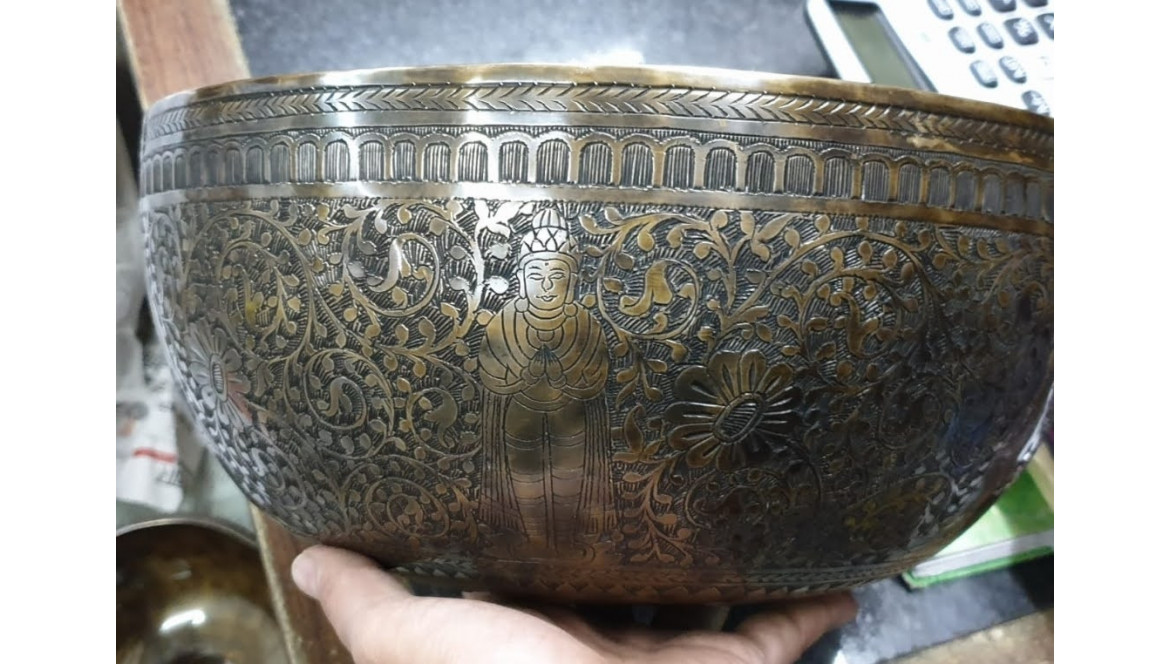
For centuries, carved singing bowls were cut by hand in the Kathmandu Valley, a skill inherited from Newari bronze statue carvers in Patan. Today most carved bowls leaving Nepal are laser engraved, and it's rarely disclosed. Here's how the shift happened, how to spot the difference, and what's quietly being lost.
For centuries, a singing bowl workshop in the Kathmandu Valley has sounded like a hand at work: the light, uneven tap of a chisel against bronze. Walk into many of those same workshops today, and that sound is being replaced by something else, the near-silent hum of a laser head burning a mantra or mandala into a bowl in minutes.
Based on conversations with manufacturers, engravers, and exporters across the valley, laser carved singing bowls have become the more typical way carved and engraved singing bowls are produced today, even though most buyers still assume the design in front of them was cut by an artisan's hand. That gap, between what people think they're buying as handmade or authentic singing bowls and what's actually leaving the workshop, is at the heart of this shift.
This article traces how that shift happened: the tradition it's displacing, how the technology advanced fast enough to make it possible, and what's genuinely at risk of disappearing.
In this article
- A short history of hand-carved singing bowls
- The rise of laser engraving in Kathmandu
- Why most carving orders now go to the machine
- Hand-carved vs machine-carved compared
- Deep carving: the most skilled work goes first
- Why this isn't really about sound
- The artisans losing ground
- How to find an authentic hand-carved bowl
- Frequently asked questions
A Short History of Hand-Carved, Handcrafted Singing Bowls in Nepal
Carving on Nepal's singing bowls, the same bowls often sold internationally as Tibetan or Himalayan singing bowls, was never just decoration. But this carving skill did not originate with the bowls themselves. It comes from a much older Newari tradition of carving bronze statues and religious icons, centred in Patan in the Kathmandu Valley, where artisans have carved mantras, deities, and lotus motifs onto sacred bronze figures for centuries.
Carvers trained for years, often within the same family line, learning this statue-carving craft first. That same freehand skill, cutting mantras, deities, lotus patterns, dragons, and the eight auspicious symbols, was later applied to singing bowls that had already been hammered and tuned.
The most demanding version, deep, high-relief carving covering most of a bowl's surface, could take a skilled carver many days of continuous labour. That's why heavily carved, handcrafted singing bowls have always commanded the highest prices: the cost was never really about the metal, it was about paying for days of trained human skill. This is the art that laser engraving is now standing in for.
The Rise of Laser Engraving in Kathmandu's Workshops
Laser engraving isn't new to Nepal. What's new is how good it's gotten. Newer fiber laser engraving machines, paired with far more capable design software, let operators reproduce almost any traditional pattern, mantras, deities, full mandalas, even custom artwork, with a fineness older setups couldn't manage.
That leap in accuracy tipped the balance. A few years ago, a machine-carved bowl was easy to spot: flat lines, an obviously mechanical look. Today, with the right settings, many aren't easy to spot at all. The gap closed fast enough that singing bowl engraving stopped being a more affordable alternative next to hand carving and started being able to stand in for it.
Most Carving Orders Now Go to the Machine, Not the Hand
This is the part most buyers haven't been told: carving orders across the valley are, by most manufacturers' own accounts, increasingly going to a machine instead of a carver. In a growing number of workshops, laser engraving has become the default way carved singing bowls are made, especially for larger orders.
A few things are driving that shift:
- Speed. A laser finishes in minutes what once took a carver days.
- Price. Machine time generally costs less than skilled labour, so laser-carved bowls tend to be more affordable.
- Disguise. Laser work now looks close enough to hand carving that most retailers and buyers can't tell the two apart, so the substitution rarely gets disclosed.
- Precision. Laser engraving is now finer and more accurate than hand carving, making designs possible that were too difficult to do by hand.
Hand-Carved vs. Machine-Carved: What a Laser Can Copy, and What It Can't
| Hand-carved bowls | Laser-engraved bowls | |
|---|---|---|
| Origin | Years of trained human skill, applied fresh to each bowl | A digital file, reproduced by machine |
| Character | Small natural variation, the trace of a specific carver | Precise, repeatable uniformity |
| Time invested | Hours to many days | Minutes to a few hours |
| What you're paying for | A person's skill and time | A machine's precision and speed |
A laser can imitate the look of hand carving closely, but it can't imitate the years spent learning the craft, or the fact that no two hand-carved bowls are ever quite the same. That difference doesn't show up in a photo. It shows up in who still has work, and in whether that artisan craftsmanship gets passed down at all.
Deep Carving: The Most Skilled Work Is Being Automated First
Deep, intricate carving used to be the clearest proof of a carver's mastery, and it priced accordingly: the more elaborate the design, the more days of hand labour it represented. That's exactly the work now being taken over by machines.
Extremely fine, high-density laser carving can reproduce much of that same visual complexity in a fraction of the time. Workshops offering this level of detail do charge more than a basic laser job, but the premium covers finer machine settings and longer run time, not hours of a carver's hands on the metal.
Why This Isn't Really About Sound
It's worth clarifying, since it's easy to assume otherwise: a singing bowl's tone comes mainly from its metal, thickness, shape, and the hammering and tuning process, not from surface carving. A laser-carved bowl and a hand-carved bowl, made from the same blank and tuned the same way, should sound comparable.
So this shift isn't a sound healing or meditation bowl performance issue. It's a cultural one. The bowl's function stays the same; what changes is the human story once built into its surface.
The Artisans Losing Ground to the Machine
Hand carving is a skill passed down through apprenticeship inside carving families and workshops. This isn't simply a story of decline: the global singing bowl market has grown a lot, and laser engraving has expanded mostly to meet that new demand, not by taking existing hand-carved orders away.
Still, as a growing share of new orders goes to laser, hand carving's slice of the market shrinks in relative terms, even as total production rises. That matters for carvers: fewer young people see a paid path into learning it, and fewer experienced carvers can live off it alone. The danger isn't that hand carving vanishes overnight, it's that the chain of people who know how to do it quietly breaks, one generation at a time.
How to Find an Authentic, Hand-Carved Singing Bowl
- Ask directly. A transparent seller will tell you whether a bowl's carving is hand-done, laser-done, or a mix of both.
- Look closely. Hand-chiselled lines carry small, natural irregularities. Laser lines tend to be very even, sometimes with a faint scorch tone.
- Watch for repetition. Several bowls with an identical pattern down to the last detail is a strong sign of laser reproduction; no two hand-carved bowls are ever perfectly alike.
- Be willing to pay for it. Genuine hand carving costs more because it represents real, trained human time.
The short version
- Most carved bowls leaving the Kathmandu Valley today are laser engraved, and it's rarely disclosed.
- Carving method does not meaningfully change a bowl's tone.
- The loss is cultural: fewer paid hours for carvers, and a shrinking path for apprentices.
Frequently Asked Questions
Are laser-carved singing bowls fake or lower quality?
No. They're genuine, functional singing bowls, and tone is typically unaffected by carving method. What differs is how the surface design was made, and what that means for artisan livelihoods and authenticity, not the bowl's function.
Why have singing bowl prices been changing?
As laser carving has become more common and more accurate, it appears to have reduced the labour cost behind finely carved bowls, affecting pricing for Nepalese singing bowls, especially heavily carved designs that once required many days of hand labour.
Does laser carving affect the sound quality of a singing bowl?
Generally, no. Tone is determined mainly by the metal alloy, thickness, and hammering or tuning process, not by surface carving.
How can I make sure I'm buying a genuinely hand-carved bowl?
Ask the seller directly about the carving method, look for natural irregularities in the linework, and where possible, buy from sources that can trace a bowl back to a specific workshop or carver.
Final Thoughts
The chisel hasn't disappeared from Kathmandu's workshops. But it's being asked to compete with a machine that works faster, cheaper, and increasingly, almost as convincingly. Knowing the difference, and choosing to ask for it, may be one of the few things still standing between this artisan tradition of handmade singing bowls and its replacement.




Comments
No comment at this time!
Leave your comment