


Do Singing Bowls Really Contain 7 Metals? The Truth Explained Simply
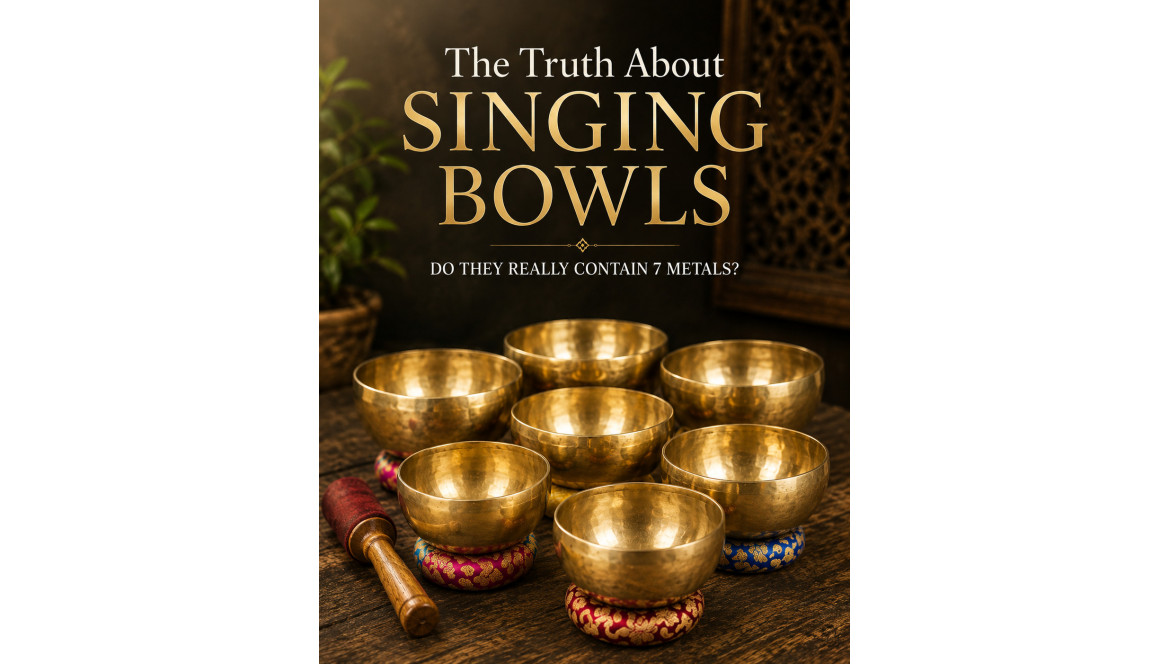
A simple guide to the truth behind the seven-metal singing bowl claim. Discover what traditional Himalayan singing bowls are actually made of, what laboratory testing reveals, and which factors really affect their sound and quality.
Do Singing Bowls Really Contain 7 Metals? The Truth Explained Simply
If you have ever shopped for a singing bowl, you have probably seen the phrase "made of seven sacred metals." Sellers in Kathmandu say it. Online shops repeat it. Many buyers believe it.
The honest answer: most singing bowls are made of bell metal bronze, roughly 78% copper and 22% tin. When old bowls are lab-tested, traces of iron, arsenic, or nickel sometimes show up, but these are impurities from the ore, not metals deliberately added. Once assays turned up several elements, the finding got misread as proof of a seven-metal recipe and then treated as ancient tradition.
The planetary symbolism, gold for the Sun, silver for the Moon, and so on, is not Himalayan at all. It is a European alchemical framework that reached singing bowls only when they entered Western spiritual markets in the twentieth century, packaged alongside simplified chakra theory.
If "bell metal" sounds vague, the industry calls it B20 bronze (CuSn20): copper with roughly 20% tin. European foundries have cast church bells from this ratio for centuries. Zildjian, Sabian, Meinl, and Paiste use it for their best cymbals. A Kathmandu singing bowl, a cathedral bell, and a professional ride cymbal are all the same family of alloy, arrived at independently by metalworkers on different continents chasing the same acoustic result.
In this guide we explain what lab testing actually finds and how to judge a bowl's quality using something more useful than a metal list.
Quick Answer
Traditional Himalayan singing bowls are made from copper and tin (bell metal bronze). Testing usually finds small traces of iron, zinc or lead, but these are impurities, not deliberate ingredients. Gold, silver and mercury have not been found in meaningful amounts in traditional bowls. Metal count does not decide sound quality. Alloy, shape, thickness and hammering do.
Where the "Seven Metals" Story Comes From
The seven-metal claim connects each metal to one of the seven classical planets of ancient astronomy and alchemy.
| Metal | Planet |
|---|---|
| Gold | Sun |
| Silver | Moon |
| Mercury | Mercury |
| Copper | Venus |
| Iron | Mars |
| Tin | Jupiter |
| Lead | Saturn |
These seven planets are the ones visible to the naked eye. Ancient cultures across Asia, the Middle East and Europe used this same list. Over time, the number seven was also linked to the seven days of the week and the seven notes of a musical scale.
While it is sometimes claimed that the seven planets also correspond to the seven chakras, this connection is largely a modern Western invention. The chakra system itself originates from ancient Indian traditions, rooted in Hindu, yogic and tantric texts. The link between planets and chakras as we know it today was popularized in the 19th and 20th centuries through Western esoteric movements such as Theosophy, which blended Indian spiritual concepts with Western occultism and astrology. This specific mapping was not part of the original Indian chakra tradition.
It is a beautiful system. It is also a spiritual map, not a metallurgical report. Somewhere along the way, the map was mistaken for the recipe.
What Metal Testing Actually Shows
Several independent analyses of old and new bowls tell a very consistent story.
The best-known study examined more than 100 Himalayan metal bowls made between the 16th and 19th centuries. Almost every bowl was simple bronze: copper and tin. A small number contained traces of iron at under 2%. No gold, no silver, no mercury was found in the bowls themselves.
It is worth noting that mercury was historically used in Nepal, particularly in statue craftsmanship. It played an important role in the gold plating process, allowing artisans to achieve a perfect and durable gilded finish on religious statues. However, due to its toxic nature, the use of mercury in Nepali craftsmanship has been abandoned for several decades now.
Modern laboratory work agrees. A published thermal and structural study of a singing bowl alloy focused entirely on high-tin bronze and its internal crystal structure. There was no complex seven-metal mixture to analyse, because there was no complex seven-metal mixture in the bowl.
Contemporary "seven metal" bowls sold today are also, in most cases, over 99% copper and tin. Any other metals appear only as traces.
The conclusion is simple. The seven-metal claim does not survive testing. What survives testing is bell metal bronze, and that turns out to be far more interesting.
What Singing Bowls Are Actually Made Of
Bell Metal Bronze
Bell metal is a specific type of bronze with an unusually high tin content. Copper makes up about 77 to 80% and tin about 20 to 23%. This is the same family of alloy used for temple bells, gongs and cymbals across Asia for many centuries. That is not a coincidence. A singing bowl is essentially an inverted bell without a clapper, which is why it is sometimes called a standing bell or resting bell.
Why the High Tin Content Matters
Ordinary bronze contains far less tin, often under 10%. Pushing tin above 20% changes the metal completely. It becomes harder and more rigid. It rings longer, since more tin means a longer decay time, so the note sustains instead of dying quickly. It produces richer overtones, the layered tones you hear circling above the main note. It also becomes brittle. This is the trade-off. A high-tin bronze bowl sings beautifully and cracks if you drop it on a stone floor.
Why This Alloy Is Difficult to Work With
Copper melts at about 1085°C. Tin melts at only about 232°C. Mixing them evenly over a traditional fire takes real skill, because molten tin oxidises and is lost easily during smelting, and it tends to separate rather than distribute evenly through the copper.
Cooling matters just as much as melting. When high-tin bronze cools slowly, a brittle internal phase forms that dulls the sound and weakens the metal. Traditional makers avoid this by heating and quenching the bowl repeatedly during hammering. Laboratory analysis of singing bowl metal confirms this: the crystal structure found inside real bowls is the kind that only appears when hot metal is cooled quickly and deliberately.
In other words, the skill is not in adding rare metals. The skill is in controlling two ordinary ones.
Bronze, Brass or Aluminium? How to Tell What You Are Buying
Not every metal bowl on the market is bell metal bronze. This table is more useful when shopping than any seven-metal claim.
| Material | Composition | Sound | Usually Found In |
|---|---|---|---|
| Bell metal bronze | Copper + high tin | Warm, complex, long sustain | Hand-hammered bowls for serious sound work |
| Standard bronze | Copper + lower tin | Decent tone, shorter sustain | Mid-range cast bowls |
| Brass | Copper + zinc | Brighter, thinner, fades quickly | Decorative and mass-produced bowls |
| Aluminium | Aluminium alloy | Very light, weak resonance | Cheap modern tourist bowls |
A quick test: a brass or aluminium bowl feels light for its size and its note dies away fast. A bell metal bowl feels dense in the hand and keeps ringing after you expect it to stop.
Why the Myth Continues
Four reasons keep the seven-metal story alive. It is a good story. Seven metals, seven planets, seven chakras makes a bowl feel cosmic rather than commercial, and that is powerful in wellness and meditation marketing. It borrows from something real, since Tibetan and Vedic traditions genuinely do prescribe particular metals for particular ritual objects, but those instructions were never a standard recipe for singing bowls. It justifies a higher price, since gold, silver and "meteorite iron" make a bowl sound rare and ancient. And almost nobody tests, since non-destructive metal analysis exists but is expensive and rarely worth it for a single customer.
A fair way to hold both truths at once: the seven-metal story is meaningful as symbolism and misleading as a material description.
What Actually Decides How a Bowl Sounds
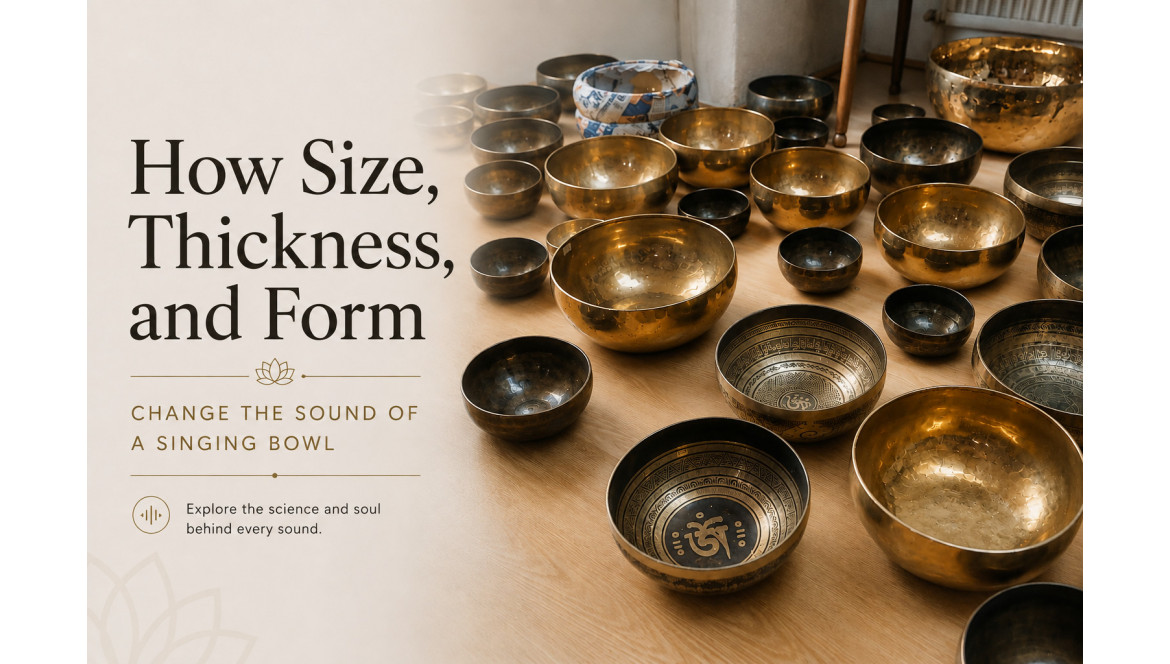
If metal count is the wrong question, here is the right one. Four things shape a bowl's voice. The alloy, since high-tin bronze gives depth and sustain that brass cannot. Thickness and weight, since thicker walls give lower, heavier tones. Shape and rim profile, since the curve of the wall and the shape of the lip change which overtones stand out. And hammering and finishing, since thousands of hammer strikes create small irregularities, which is exactly why no two singing bowls sound the same.
Age adds a fifth factor, which is why antique and new bowls can differ even when the alloy is identical.
What We Tell Our Customers
At Healing Singing Bowls in Nepal, we work directly with Newar artisan families in the Kathmandu Valley. We have never seen a workshop melt gold or silver into a bowl.
What we do see is copper and tin, a charcoal fire, and hands that have been shaping this alloy for three generations. We select every bowl by listening to it, not by counting metals in it. If a bowl sings, it sings because of the alloy ratio, the hammering and the shape, and because someone who knew what they were doing made the decisions.
We think that is a better story than the seven metals one. It is also true.
Frequently Asked Questions
Are Tibetan singing bowls made of seven metals?
Almost never. Metal analysis of both antique and modern bowls consistently finds copper and tin, with only trace amounts of other elements. The seven-metal description is symbolic rather than literal.
Do any singing bowls contain gold or silver?
A very small number of contemporary bowls are made with added precious metals, usually as a premium product. Traditional and antique bowls do not contain them in measurable quantities.
Does a seven-metal bowl sound better than a bronze bowl?
No. There is no evidence that adding more metals improves tone. Sound quality comes from the copper-to-tin ratio, the thickness, the shape and the quality of the hammering.
What is bell metal bronze?
It is a high-tin bronze, roughly 78% copper and 22% tin, used for centuries to make bells, gongs and cymbals. It is hard, brittle and unusually resonant, which is exactly what a singing bowl needs.
Is my bowl fake if it is not seven metals?
Not at all. A genuine hand-hammered bell metal bronze bowl is the authentic article. A bowl advertised as seven metals is more likely to be following a marketing convention than describing its contents.
How can I tell if my bowl is bronze or brass?
Brass bowls are lighter, often yellower, and their note fades quickly. Bronze bowls are heavier for their size and sustain much longer. Hammer marks across the surface also point towards a hand-made bronze bowl.
In Same Category
- Inside Kathmandu’s Singing Bowl Finishing Industry
- How Size, Thickness, and Form Change the Sound of a Singing Bowl
- Hand-Hammered Singing Bowls: The Step Machines Replaced
- The Laser Revolution: How Machine Carving Is Quietly Replacing Nepal's Hand-Carved Singing Bowl Tradition
- Nepal's Gong Industry Is Quietly Moving to China


Comments
No comment at this time!
Leave your comment