


How Size, Thickness, and Form Change the Sound of a Singing Bowl
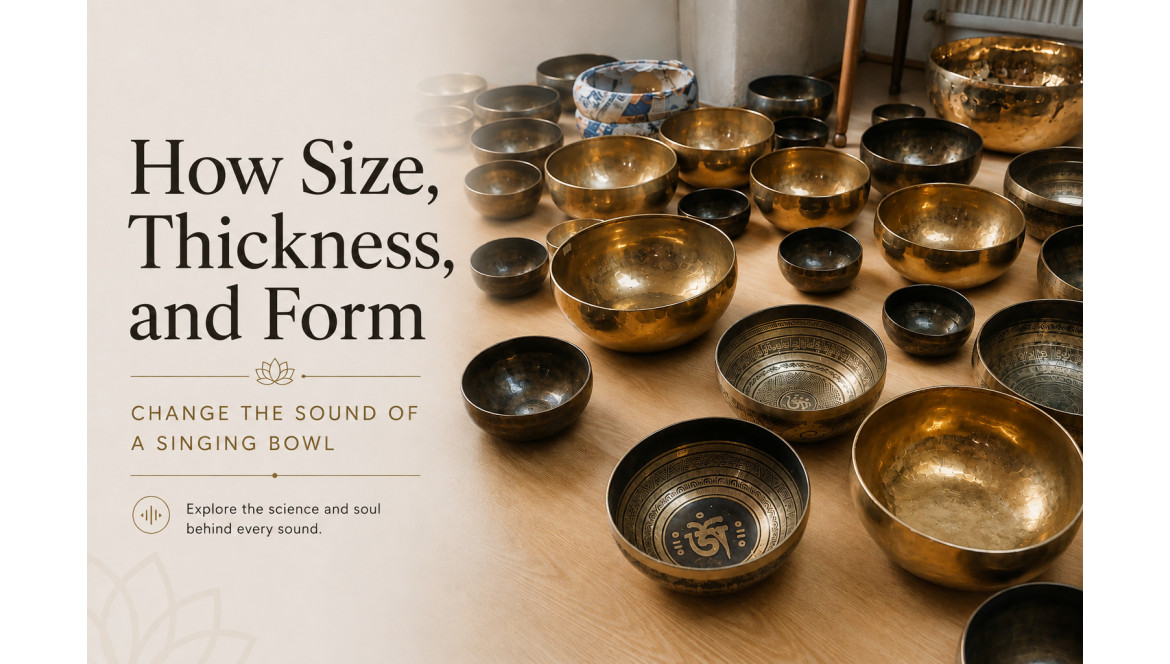
The three features behind a bowl's voice – size, thickness, and form – and how they shape pitch, resonance, overtones, and overall sound.
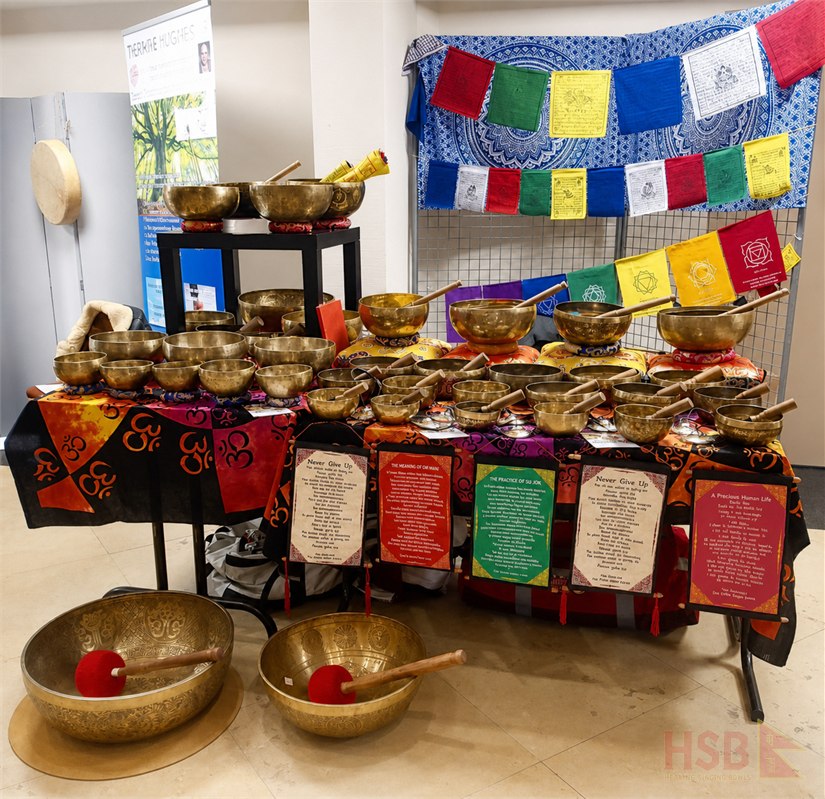
How Size, Thickness, and Form Change the Sound of a Singing Bowl
The three features behind a bowl's voice
Two singing bowls can have the same diameter, colour, and price yet sound completely different. One may produce a low, slow tone that feels like a temple bell in a valley. The other may sound bright, focused, and high, almost like a small glass.
Why?
The answer is not size alone. A singing bowl's sound is shaped mainly by three physical features:
- Size determines the general pitch range.
- Thickness changes the stiffness and vibrational response of the metal.
- Form changes the way the bowl's walls vibrate, project sound, and produce overtones.
Material, hammering, rim design, and small irregularities also matter. However, size, thickness, and form give you the most useful starting point when comparing bowls.
Quick Summary
- Larger bowls generally produce lower and fuller tones.
- Smaller bowls generally produce higher and brighter tones.
- Thicker walls are usually stiffer and can raise the pitch of a bowl with the same diameter.
- Form changes the balance between the fundamental tone and its overtones.
- Open forms, such as many Manipuri bowls, often create a broad, open sound.
- More enclosed or rounded forms, such as some Cobrebati bowls, can concentrate resonance and produce a focused tone.
- Form does not work independently. A thin, large Cobrebati may still sound lower than a thick, smaller Manipuri.
- The sound of the individual bowl is more reliable than its name or shape category.
Scientific research confirms that singing bowls produce several vibrational modes rather than one perfectly isolated frequency. The bowl's geometry, material, and construction determine which modes are excited when it is struck or played around the rim.
1. Size: The Foundation of Pitch
The simplest rule is: larger bowls usually sound lower. Smaller bowls usually sound higher.
A large bowl has a greater vibrating surface and tends to flex more slowly. Slower vibration creates a lower frequency. A smaller bowl vibrates more quickly, producing a higher and brighter sound.
This is similar to the difference between a cello and a violin. The larger instrument generally produces deeper tones, while the smaller instrument responds in a higher register.
Typical Tendencies by Size
| Bowl Size | General Sound Tendency | Common Use |
|---|---|---|
| Under 12 cm | Bright, quick, focused | Travel, personal practice, accents |
| 12–20 cm | Balanced and versatile | Meditation, daily practice |
| 20–28 cm | Fuller, deeper, more resonant | Individual or small-group sessions |
| Over 28 cm | Low, spacious, room-filling | Sound baths and fixed installations |
These are only broad tendencies. A size chart cannot predict the exact note of a hand-hammered bowl because thickness and form may shift the frequency considerably. Independent singing-bowl guides also note that diameter, thickness, density, material, and shape all influence the final sound.
A large bowl is therefore not automatically lower than every smaller bowl. A thick-walled 20-centimetre bowl may produce a higher note than a thin-walled 16-centimetre bowl, depending on how both were made.
2. Thickness: Stiffness Changes the Response
Thickness is one of the most overlooked factors when buyers compare bowls. Two bowls may have the same diameter but very different wall thicknesses. The thicker bowl contains more metal and is usually stiffer. The thinner bowl flexes more easily.
For bowls of otherwise similar size and form:
- Thicker walls usually resist bending more strongly.
- Greater stiffness can increase the natural frequency.
- Thin walls usually flex more freely.
- Flexible walls often create a deeper, more rounded response.
This is why two bowls of the same diameter can sound far apart in pitch.
However, thickness should not be explained as a simple "more metal equals higher pitch" rule. Adding metal increases both stiffness and mass. The final result depends on which effect dominates, as well as on the bowl's curvature, rim, base, alloy, and hammering pattern.
This is also why it is safer to say that thicker walls often raise the pitch for a comparable bowl, rather than claiming that they always do.
A thin, wide bowl may produce a deep and spacious tone. A thick bowl of the same width may sound more focused, higher, and more concentrated.
When buying online, diameter without any information about wall thickness is incomplete. Ask whether the bowl is thin, medium, or thick for its size, and request a recording of the exact bowl whenever possible.
3. Form: The Shape of the Sound
Form is more than appearance. It describes the overall profile of the bowl, including:
- How open or enclosed the bowl is.
- How steeply the walls rise.
- Whether the sides curve outward or inward.
- The width and shape of the rim.
- The relationship between the bowl's height, diameter, and base.
- How the wall thickness changes from the bottom to the rim.
These details affect the bowl's vibrational modes. They also influence the balance between the fundamental tone, higher partials, sustain, and perceived brightness.
Two bowls can have the same diameter and thickness but sound different because their forms distribute vibration differently.
Open Forms
An open bowl has a broad mouth and a more outward-facing profile. Manipuri bowls are commonly associated with this open, dish-like structure. An open form may produce:
- A broad and spreading sound.
- A clear initial response.
- More noticeable upper overtones.
- A tone that feels spacious rather than enclosed.
- A relatively open relationship between the strike and the sound's projection.
In your product range, an open Manipuri may sound lower and more expansive than a more rounded bowl of a similar diameter. That is a useful description of your observed bowls, but it should not be presented as a universal rule for every Manipuri bowl.
Rounded or Spherical Forms
A rounded or spherical bowl has more enclosed, curved walls. Cobrebati bowls are often described in this way, although individual examples vary considerably. A rounded form may produce:
- A concentrated resonance.
- A focused central tone.
- Strong interaction between the fundamental and upper partials.
- A more contained or "held" sound.
- A distinctive ringing quality that may seem higher, brighter, or more intense.
Some sellers describe Cobrebati bowls as producing deep tones, especially when the bowl is thin-walled and large. One listed 18.6-centimetre Cobrebati, for example, was described as producing a G4 at 422 Hz, while other listings emphasize a deep response.
This apparent contradiction is important. "Spherical" does not automatically mean "high frequency." A spherical bowl may sound high in one collection and low in another because its size, thickness, rim, alloy, and hammering are different.
4. Comparing Common Forms
Traditional names are useful, but they describe families of shapes rather than perfectly standardized acoustic categories.
| Form | General Construction | Common Sound Tendency |
|---|---|---|
| Manipuri | Open, shallow, flared profile | Broad, open, clear, sometimes lower than expected |
| Thadobati | Higher walls and flatter base | Focused, stable, balanced tone |
| Jambati | Wide body with sloping sides | Deep, spacious, resonant |
| Ultabati | Open, curved profile | Low, smooth, slowly developing resonance |
| Cobrebati | Rounded or bulging profile | Concentrated resonance; pitch varies greatly by thickness and diameter |
| Mani | Compact form with strong wall structure | Often bright, focused, and higher for its size |
These descriptions are tendencies, not guarantees. The same form can produce different notes because handmade bowls are not manufactured to one exact acoustic specification. A 20-centimetre thin Jambati and a 20-centimetre thick Jambati may not sound alike. Likewise, two Cobrebati bowls with the same diameter may differ in pitch, sustain, and overtone balance.
5. Why Form Changes More Than Pitch
Form affects the overall acoustic profile, not only the main frequency. It can change:
- Attack: how quickly the sound appears after the strike.
- Brightness: how prominent the upper frequencies are.
- Sustain: how long the tone continues.
- Projection: whether the sound spreads widely or feels concentrated.
- Beating: the slow pulsation created when closely related frequencies interact.
- Overtones: the additional tones heard above the fundamental.
Research on Tibetan singing bowls has shown that their sound is produced by complex wall vibrations and fluid-surface interactions. The bowl does not vibrate as one completely uniform object; it moves through different modes, each contributing to what the listener hears.
Small asymmetries caused by hand-hammering can also split a vibrational mode into nearby frequencies. This can create the gentle beating or pulsating quality associated with many traditional bowls. That is one reason handmade bowls often sound more complex than a simple musical note.
6. Form and the Experience of Sound
The words "low" and "high" describe frequency, but they do not describe the entire experience.
A low-frequency bowl may feel:
- Broad.
- Slow.
- Spacious.
- Grounding.
- Physically present.
A high-frequency bowl may feel:
- Bright.
- Clear.
- Focused.
- Quick to respond.
- More concentrated around the ears and upper body.
These descriptions are subjective. They should be used as listening language rather than medical claims. A bowl's perceived body sensation also depends on volume, room acoustics, the player's technique, the cushion, and the listener's position. Therefore, it is better to say that some bowls are often perceived as grounding or focused rather than claiming that one frequency produces a guaranteed physical or therapeutic effect.
7. Choosing by Size, Thickness, and Form
For Beginners and Daily Practice
Look for:
- Size between 12 and 18 centimetres.
- Medium wall thickness.
- A stable base or comfortable hand-held form.
- A clear fundamental with a manageable amount of overtone activity.
- A form that responds easily to a light rim stroke.
A medium Manipuri may be suitable if you prefer an open, spreading tone. A medium Thadobati may be better if you want a more focused and stable note.
For Deep Meditation and Sound Baths
Look for:
- A larger diameter, usually 20 centimetres or more.
- Thin or medium walls if you want a deeper response.
- A broad or rounded form with good sustain.
- A stable cushion and fixed playing position.
- A recording that demonstrates both striking and rim playing.
Jambati, Ultabati, and some larger Cobrebati bowls may work well for this purpose, but the individual recording matters more than the style label.
For Bright Accents and Layered Sets
Look for:
- A smaller diameter.
- Medium or thicker walls.
- A focused form such as a compact Mani or Thadobati.
- A clear attack and distinct upper partials.
- A note that contrasts with your larger bowls.
If you are building a set, do not choose bowls only by size. Compare their actual frequencies and listen to how their overtones interact.
8. A Better Buying Checklist
Before purchasing a bowl, ask for:
- The diameter, measured across the rim.
- The height and overall profile.
- A description of the form: open, shallow, straight-sided, rounded, or enclosed.
- The approximate wall thickness.
- The weight, as supporting information rather than the main acoustic criterion.
- The fundamental note or measured frequency.
- An audio or video recording of the exact bowl.
- A demonstration of both striking and rim playing.
- The approximate sustain time.
- Information about the metal and manufacturing method.
Weight is still useful, but it should no longer be one of the three main criteria. It can help you estimate portability, stability, and physical presence, but it does not determine the pitch by itself.
Frequently Asked Questions
Does a larger bowl always sound lower?
Usually, but not always. Size establishes the broad pitch tendency, while thickness and form can shift the final frequency.
Does a thicker bowl always sound higher?
No. A thicker wall is often stiffer and may raise the pitch compared with a thinner bowl of the same size and form, but the result also depends on mass, curvature, alloy, rim, and hammering.
Does an open Manipuri always have a low frequency?
No. Open Manipuri bowls can sound broad and low in some collections, but their actual pitch varies with diameter, thickness, and construction.
Does a spherical Cobrebati always have a high frequency?
No. Some spherical Cobrebati bowls may sound focused or high, but other examples are described as deep and resonant. Online listings show that Cobrebati pitch is not standardized by form alone.
Which matters more: form or size?
Size is generally the strongest first indicator of pitch. Form becomes especially important when comparing bowls with similar diameters, because it affects stiffness, resonance, projection, and overtone balance.
How can I know the exact frequency?
Use a tuner or frequency-analysis app as a rough guide, but test the bowl in a quiet room and allow the sound to develop. A singing bowl produces several frequencies, so the number shown by a phone app may be a prominent partial rather than the fundamental.
Final Thoughts
Size gives you the starting point. Thickness changes the stiffness of the vibrating wall. Form determines how that vibration is organized, projected, and heard.
That is why a buyer should not ask only, "How wide is the bowl?" A better set of questions is:
- How large is it?
- How thick are the walls?
- Is the form open, shallow, straight-sided, or rounded?
- What is the measured frequency?
- How does the exact bowl sound when struck and played around the rim?
At Healing Singing Bowls, we measure and record each bowl before shipping because size alone cannot describe a bowl's voice. The real character emerges from the interaction between size, thickness, and form.
In Same Category
- Inside Kathmandu’s Singing Bowl Finishing Industry
- Do Singing Bowls Really Contain 7 Metals? The Truth Explained Simply
- Hand-Hammered Singing Bowls: The Step Machines Replaced
- The Laser Revolution: How Machine Carving Is Quietly Replacing Nepal's Hand-Carved Singing Bowl Tradition
- Nepal's Gong Industry Is Quietly Moving to China




Comments
No comment at this time!
Leave your comment