


Two seven-bowl sets can be linked to the same seven chakras and still use different musical notes. The difference often comes from the teaching framework behind the set. Understanding that framework helps you choose bowls, explain them to your clients and follow a course consistently.
This guide compares two mappings used in contemporary singing bowl practice: the C–D–E–F–G–A–B mapping commonly called Vedic and the F–C–G–D–A–E–B Himalayan mapping used in Santa Ratna Shakya’s approach.
These contemporary teaching frameworks are distinct from the history of the objects themselves. Read about the history and origins of singing bowls for that historical context.
What do “Vedic” and “Himalayan” mean here?
These names identify approaches to associating musical notes with chakras. The first assigns the ascending C-major scale to the chakras, from root to crown. The second assigns the sequence F–C–G–D–A–E–B.
Practitioners and teachers may use different names or correspondences. “Vedic” is a familiar label in modern singing bowl practice; the label alone does not establish that this exact musical mapping comes from ancient Vedic texts. Likewise, the Himalayan mapping described here is a particular teaching framework, rather than a rule followed by every practitioner in the Himalayan region.
Both can provide a coherent structure for a session. A chakra–note association is a symbolic or teaching correspondence: it does not mean that a chakra has one universally established acoustic frequency.
The seven chakras: comparing the two mappings
Read the table from the root chakra to the crown chakra. In fixed-do solfège, letter names and solfège refer to the same notes: C is Do, D is Ré, E is Mi, F is Fa, G is Sol, A is La and B is Si.
| Chakra | Common Vedic mapping | Himalayan / Santa mapping |
|---|---|---|
| Root | C — Do | F — Fa |
| Sacral | D — Ré | C — Do |
| Solar plexus | E — Mi | G — Sol |
| Heart | F — Fa | D — Ré |
| Throat | G — Sol | A — La |
| Third eye | A — La | E — Mi |
| Crown | B — Si | B — Si |
The notes alone do not identify the approach: both mappings use the same seven letter names. Their order and their chakra associations are what change. For example, F corresponds to the heart in the first mapping and to the root in the second.
Example arrangements of the seven bowls
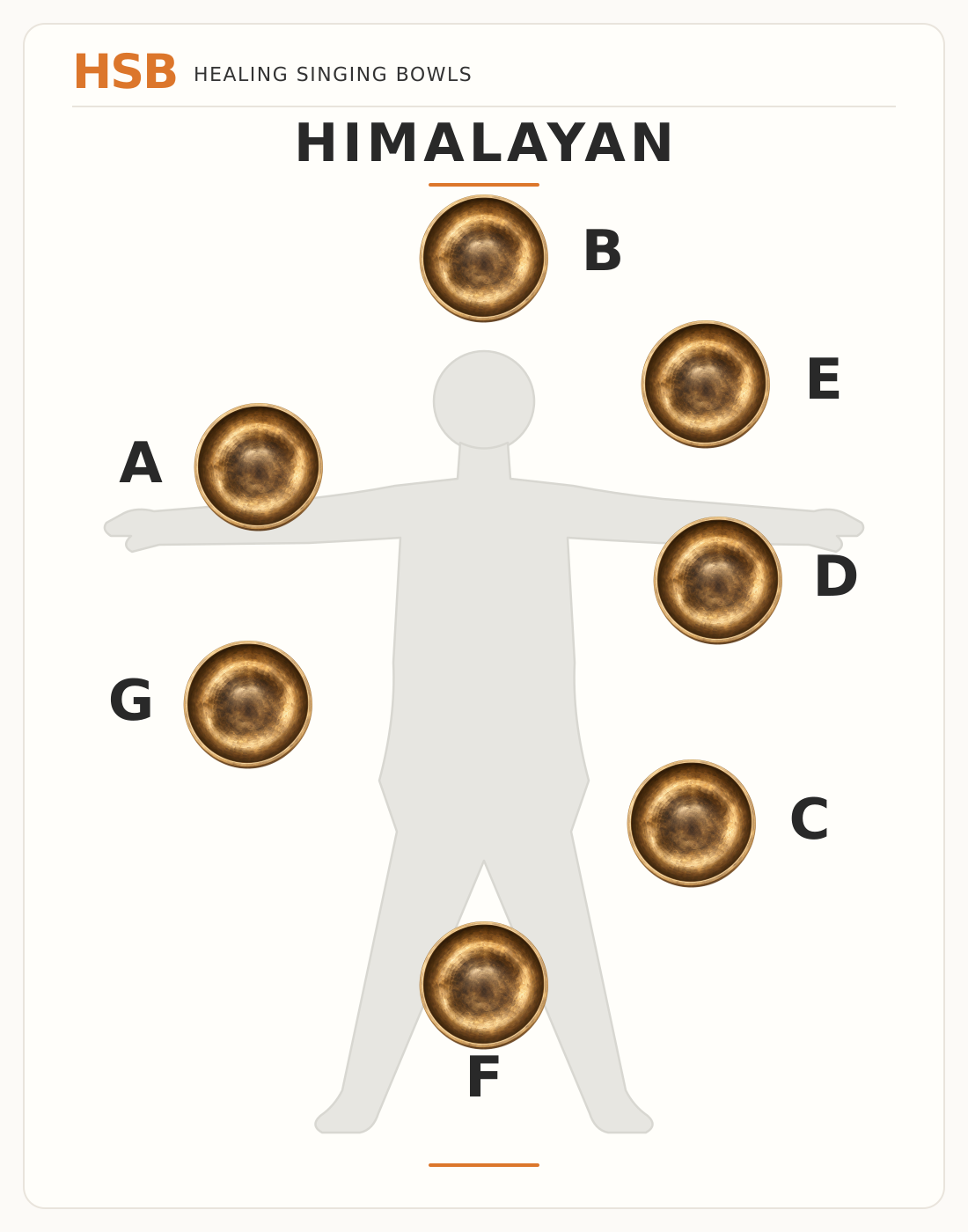
These diagrams illustrate the physical placement of the bowls. Bowl placement and the symbolic note–chakra correspondences are different things: moving a bowl does not by itself change the mapping described in the table.
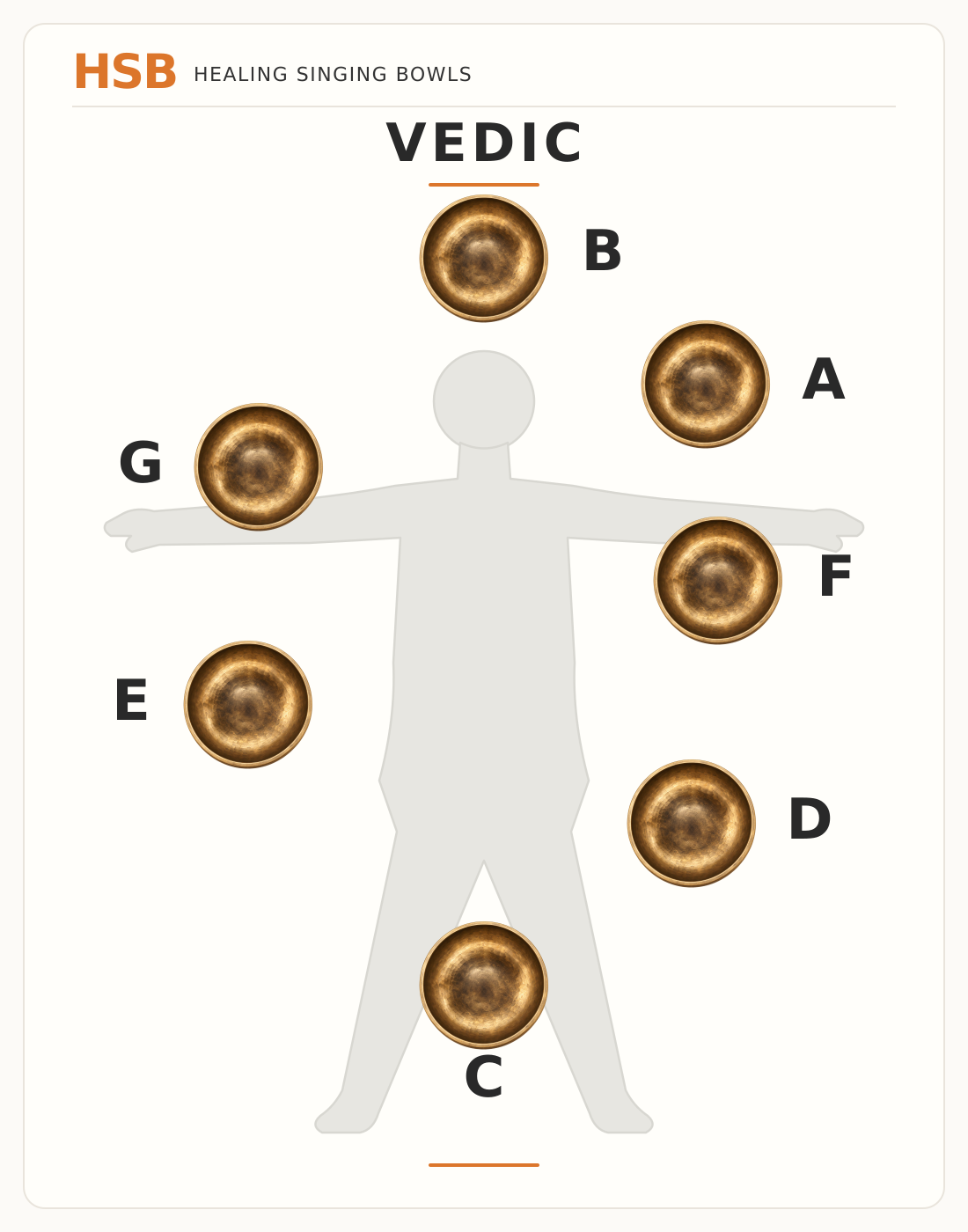
Example bowl layout for the Vedic C–D–E–F–G–A–B sequence.
Example bowl layout for the Himalayan F–C–G–D–A–E–B sequence.
A note, an octave and a frequency are different things
A note name identifies a pitch class. Its octave tells you its register, and its frequency gives a measured pitch in hertz. In scientific pitch notation, at an A4 = 440 Hz reference in twelve-tone equal temperament, C3 is approximately 130.81 Hz and C4 approximately 261.63 Hz. Moving up one octave doubles the frequency without changing the letter name.
For a C–D–E–F–G–A–B set, one possible arrangement is C3, D3, E3, F3, G3, A3 and B3, spanning approximately 130.81 to 246.94 Hz. Other octaves are possible.
The Himalayan letter order follows successive fifths. The actual bowls can occupy neighbouring registers instead of continually rising in pitch. One illustrative arrangement is F2, C3, G2, D3, A2, E3 and B2: approximately 87.31, 130.81, 98.00, 146.83, 110.00, 164.81 and 123.47 Hz respectively. This example explains octave choices; it is not a specification for every Himalayan set.
These are theoretical reference pitches. Handmade singing bowls have their own measured frequencies, which may differ slightly. Octave numbering can also vary between sources, so compare the frequency as well as the written note.
Does 432 Hz change the chakra mapping?
A = 440 Hz and A = 432 Hz describe the reference used to calculate musical pitches. Choosing 432 Hz lowers the reference pitches by approximately 1.8%. It does not change the order of the notes or turn one chakra mapping into the other.
A bowl marked C is not necessarily a bowl sounding at 432 Hz. Ask which note, octave and measured frequency are being described, and which tuning reference was used.
Listen to the whole bowl
A singing bowl produces several resonant tones. Its lower principal tone and higher partials can be heard differently depending on where and how you strike or rub it. Those higher tones do not necessarily follow the exact harmonic pattern of an ideal string.
When comparing bowls, check which tone the stated note describes. Then listen to recordings for timbre, sustain and how the bowls blend. A note label is useful, but it cannot describe the full listening experience.
Which approach should you choose?
If you are following a teacher or training programme, start with its mapping and octave requirements. A consistent framework makes instruction and session planning easier.
For the ascending C–D–E–F–G–A–B approach, explore the singing bowl sets from Healing Singing Bowls (HSB). For Santa’s approach, see the Himalayan F–C–G–D–A–E–B set and Santa Ratna Shakya’s method.
If you are assembling a set or adding a bowl, our Full Moon bowls by note let you consider individual notes. Check their measured pitches against your existing bowls. For retailers and trainers, clearly stating the chosen mapping helps customers understand what they are buying.
Frequently asked questions
Which note corresponds to the root chakra?
In the common C–D–E–F–G–A–B mapping, it is C. In the Himalayan / Santa mapping described here, it is F. Always specify the framework alongside the correspondence.
Can I use the same bowls for both approaches?
Both use the seven note names C through B, so a set may support both mappings. Check its octaves and measured pitches against your teacher’s requirements, then adapt the chakra assignments.
Is one approach scientifically better?
The musical differences can be described and measured. The chakra assignments themselves are teaching correspondences; this comparison does not establish a clinical advantage for either mapping.
Should every bowl be in the same octave?
That depends on the set and the practice. An ascending scale can fit within one octave, while a Himalayan arrangement can combine registers. Check the actual pitches and listen to the combination.
This guide adapts the comparison presented by Namaste Thonon, with scientific pitch notation used for the frequency examples.