


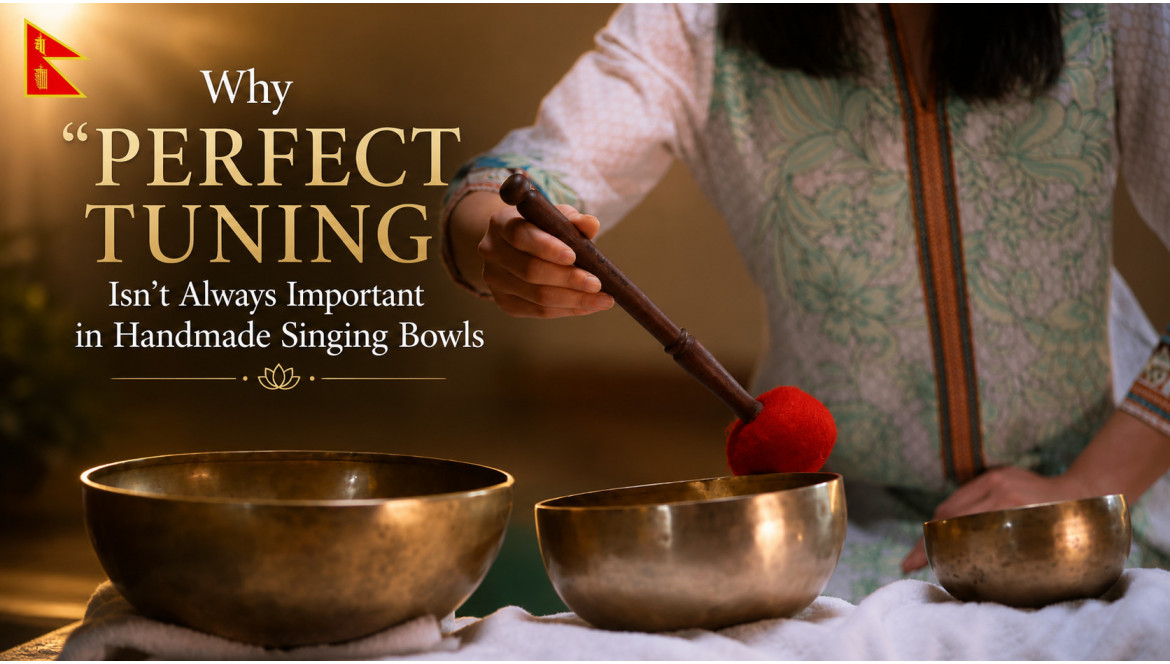
Why "Perfect Tuning" Isn't Always Important in Handmade Singing Bowls
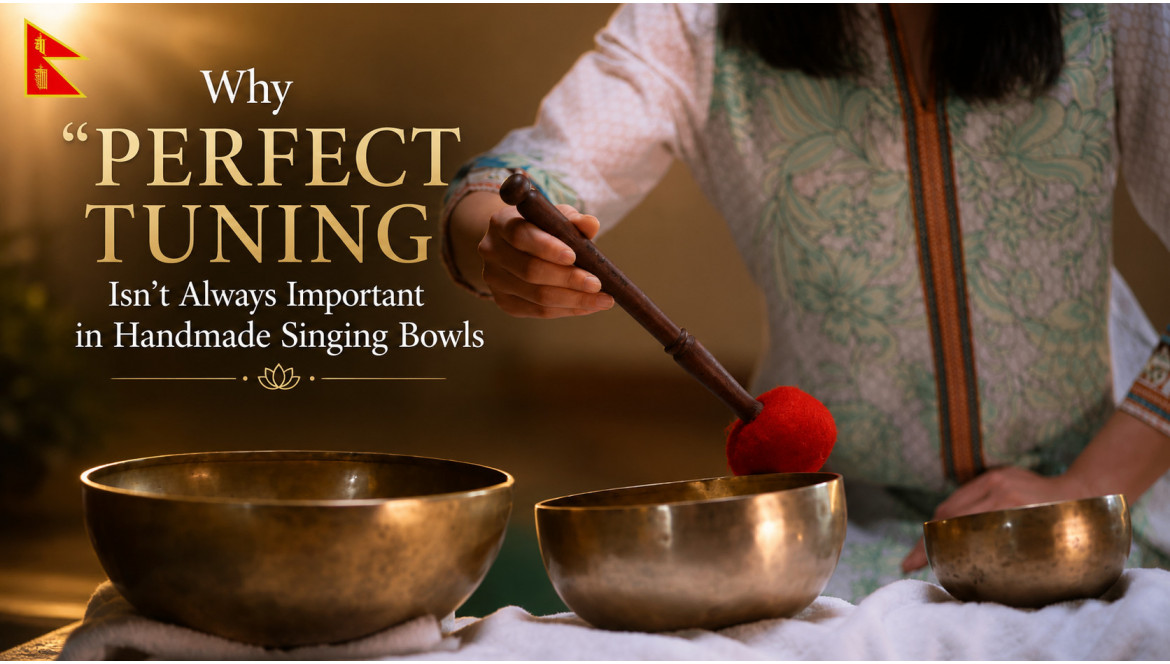
A deep dive into the acoustic nature of handmade Himalayan singing bowls, explaining why pitch perfection matters less than clarity, sustain, overtones, and the characteristic pulsating "wah-wah" sound.
Why "Perfect Tuning" Isn't Always Important in Handmade Singing Bowls
Many buyers ask the same question before purchasing: "Is this bowl perfectly tuned?"
It is a fair question. We are used to instruments that hit exact notes. A piano is tuned. A guitar is tuned. A crystal bowl can be manufactured to an exact frequency.
But a hand-hammered Himalayan bowl works differently. Its note is not designed in advance. It emerges from the metal during making, and it is discovered afterwards.
Once you understand why, "perfect tuning" stops looking like a mark of quality and starts looking like the wrong question to ask.
What People Mean by "Perfect Tuning"
The phrase usually means one of three things. A standard musical pitch, where the bowl matches a note like C, D or E based on the tuning system where A4 equals 440 Hz. A "spiritual" tuning, usually 432 Hz, often marketed as more natural or more healing than 440 Hz. Or a matched set, where several bowls sit close enough together to sound harmonious when played as a group. The third meaning is the useful one. The first two are largely borrowed from Western instrument-making and do not fit the craft.
How a Handmade Bowl Gets Its Note
A traditional bowl begins as a disc of bell metal bronze. A team heats the metal, hammers it, reheats it, and hammers again. Thousands of strikes over many rounds gradually raise the walls and shape the curve.
Nobody is aiming at 184 Hz. The makers are watching the shape, listening to the ring, and judging when the wall is right.
Four things then decide the final pitch. Diameter, since wider bowls sound lower. Wall thickness, since thicker walls sound higher, sometimes an octave higher than a thin bowl of the same width. Alloy, since small differences in the copper-to-tin ratio change how stiff and dense the metal is. And hammer pattern, since no two bowls receive the same sequence of strikes, so no two carry the same internal stress map.
Experienced makers do have rough control. They know that a heavier disc gives a lower bowl, and they can adjust the pitch a little near the end by hammering the rim or thinning a section. But that is influence, not precision. The final note lands where the metal decides.
Why the "Imperfection" Is the Point
A singing bowl does not produce one clean frequency. It produces a fundamental note plus many partials ringing at the same time. Unlike a guitar string, those partials are not neat multiples of the fundamental. A bowl is a curved three-dimensional shell, so its vibration patterns follow more complicated rules. This is why bowls belong to the same acoustic family as bells and gongs, not pianos.
Because the wall thickness varies slightly around the circumference, and because the bowl is never perfectly circular, each vibration pattern splits into two very close frequencies instead of producing one. A partial that should ring at exactly 200 Hz might ring at 197 Hz and 203 Hz at the same time.
When two close frequencies sound together, you hear a slow pulse. Louder, softer, louder, softer. Practitioners call it the "wah-wah." That pulse only exists because the bowl is imperfect. A machine-made bowl with perfectly even walls produces a flatter, simpler, more static sound. The irregularity you cannot see is exactly what you can hear.
What the Research Shows, and What It Does Not
There is one published study worth knowing about. Researchers played a bowl that pulsed at about 6.68 times per second to seventeen listeners and measured their brain activity. They found a marked increase in activity at that same pulse rate, which falls in the theta range associated with relaxed, meditative states.
That is a genuine result and it supports what practitioners have long described. But be careful with how it is reported online. It is a single small study. Increased activity at a matching frequency is not the same as a proven health benefit. And the pulse rate of a bowl is not always in the theta range — depending on the bowl, the beats can be much slower or much faster.
So the honest version is this: the pulsing sound of a hand-hammered bowl appears to engage the brain in a measurable way, and it reliably feels calming. Anyone claiming more than that is going beyond the evidence.
Selection Is Not the Same as Tuning
Nobody tunes a hand-hammered bowl to a note. But you can select one.
A workshop produces hundreds of bowls. Each comes out with its own pitch. If you measure them all, you will find bowls scattered across the whole range, and some of them will sit very close to a recognised note.
That is how a bowl can honestly be sold as "C5" or as part of a matched octave set. It was not engineered to that note. It was found at that note, out of a large number of bowls, by someone who measured and listened.
Selection takes time and it requires stock. It is real work, and it is a legitimate reason for a bowl to cost more. But it is a completely different process from tuning, and buyers deserve to know which one they are paying for.
When Tuning Actually Does Matter
"Not the main thing" does not mean "never relevant." There are three situations where pitch relationships matter.
Building a Set
If you want several bowls to sound good together, their relationships matter. Some sellers give a "cents" measurement showing how far each bowl sits from a standard note, and suggest keeping a set within a narrow range so it does not sound discordant. This is useful as a rough filter. It is not a substitute for hearing the bowls played together, because two bowls can be numerically close and still clash in their overtones.
Playing with Other Instruments
If you accompany a guitar, a harmonium, group chanting in a fixed key, or a planned harmonic progression in a sound bath, then you need bowls near recognisable notes. Here, selected bowls or purpose-made tuned bowls genuinely help.
Crystal Bowls
Crystal bowls are a different case entirely. They are manufactured from quartz and can be made to precise frequencies. For crystal, tuning is a real specification rather than a marketing phrase. Even so, how a crystal set sounds together matters more than whether it says 432 or 440 on the label.
What to Prioritise Instead
If you are buying one bowl for personal practice or meditation, ignore the number and judge these four things. Clarity, meaning whether the tone comes through cleanly or sounds muddy and confused. Sustain, meaning how long it rings after you strike it, since good bell metal bronze keeps going longer than you expect. Depth of overtones, meaning whether you can hear fainter tones circling above the main note, since a flat single-layer sound usually means brass or a machine-made bowl. The pulse, meaning that slow "wah-wah" swell that is the signature of a well-made hand-hammered bowl. And your own response, since if a bowl irritates you, you will not use it, and the bowl you actually reach for every day is worth more than a technically superior bowl sitting in a cupboard.
Four Myths Worth Clearing Up
"If it is not exactly 432 Hz, it is not healing."
There is no evidence that any single frequency has special healing properties. The effect of a bowl comes from its whole sound field, not one number.
"A perfectly tuned bowl is always better."
For handmade metal bowls, over-correcting the pitch means removing metal and evening out the walls, which strips away the overtones and the pulsing. You would be paying more for a thinner sound.
"Singing bowls should match piano notes exactly."
Bowls are inharmonic instruments. They are relatives of bells and gongs, not of pianos. Expecting a piano-like single pitch misunderstands what the instrument is.
"Two bowls that look the same should sound the same."
Tiny differences in wall thickness, alloy and hammering make every bowl acoustically unique. This is the most common surprise for first-time buyers, and the most reliable proof that a bowl is genuinely handmade.
Frequently Asked Questions
Are handmade singing bowls tuned to specific notes?
Not during making. The pitch emerges from the size, thickness, alloy and hammering. Bowls sold by note have usually been measured and selected from a large stock rather than tuned.
Is 432 Hz better than 440 Hz for singing bowls?
There is no scientific evidence that it is. For traditional hand-hammered bowls the distinction is not meaningful, because the bowls were never built around either reference pitch.
Why does my bowl not match any note on my tuner app?
Because most handmade bowls sit between notes. This is normal and not a defect. A bowl also produces several partials at once, so a tuner can struggle to settle on one reading.
Does an out-of-tune bowl still work for meditation?
Yes. Clarity, sustain and the pulsing quality of the tone matter far more than whether the pitch matches a standard note.
How do I choose bowls that sound good together?
Ask for the note or cents measurement as a starting filter, then listen to the bowls played together before deciding. Numbers narrow the choice. Ears make the decision.
Are machine-made bowls better tuned?
They are often closer to a standard note, because the manufacturing is more consistent. But that consistency also removes the mode splitting that produces the pulse, so the sound is usually flatter and shorter.


Comments
No comment at this time!
Leave your comment