


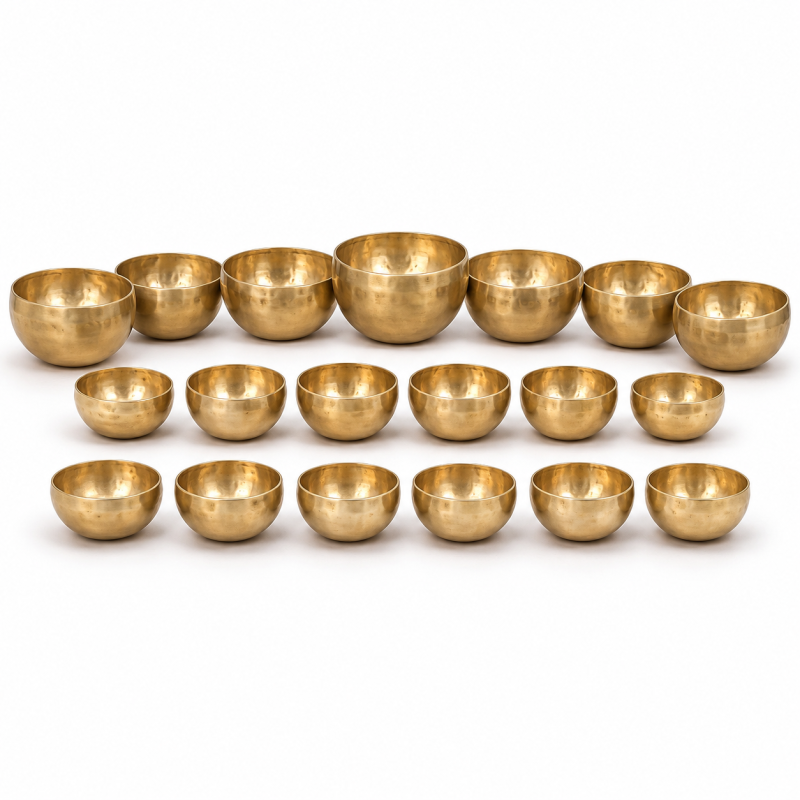
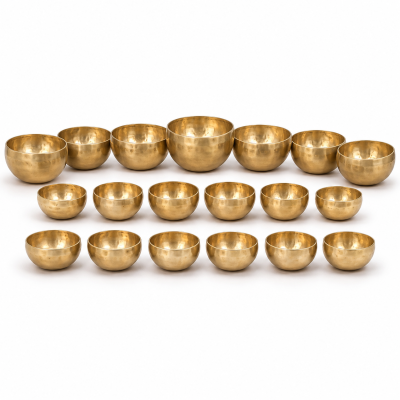
19 handmade singing bowls: seven natural notes in octave 3, plus all 12 chromatic notes in octave 4. Combine a lower register with semitone progressions above it, and explore octave pairs across both sets. Natural golden finish; indicative total bowl weight: 16.7–17.7 kg.
19 handmade singing bowls: seven natural notes in octave 3, plus all 12 chromatic notes in octave 4. Combine a lower register with semitone progressions above it, and explore octave pairs across both sets. Natural golden finish; indicative total bowl weight: 16.7–17.7 kg.
 5% discount for 500 € order
Get 500 € in your cart to obtain 5% discount!
10% discount for 1'000 € order
Get 1'000 € in your cart to obtain 10% discount!
15% discount for 2'000 € order
Get 2'000 € in your cart to obtain 15% discount!
 Secure payment
Pay securely by card, PayPal, or bank transfer.
 Transparent shipping cost
Shipping costs are calculated automatically based on weight and delivery country.
 Authentic products from Nepal
Handcrafted by Newari artisans in the Kathmandu Valley.
This kit combines a seven-note third-octave set (C3, D3, E3, F3, G3, A3, B3) with a 12-note chromatic fourth-octave set (C4, C#4, D4, D#4, E4, F4, F#4, G4, G#4, A4, A#4, B4). You have a lower register for recurring notes and a higher register with every semitone. The third octave contains the seven natural notes; this is not two fully chromatic octaves.
At the A4 = 440 Hz reference, the lower set runs from 130.8 to 246.9 Hz and the upper set from 261.6 to 493.9 Hz. Notes with the same name are one octave apart: the upper target frequency is twice the lower one, as with A3 at 220 Hz and A4 at 440 Hz.
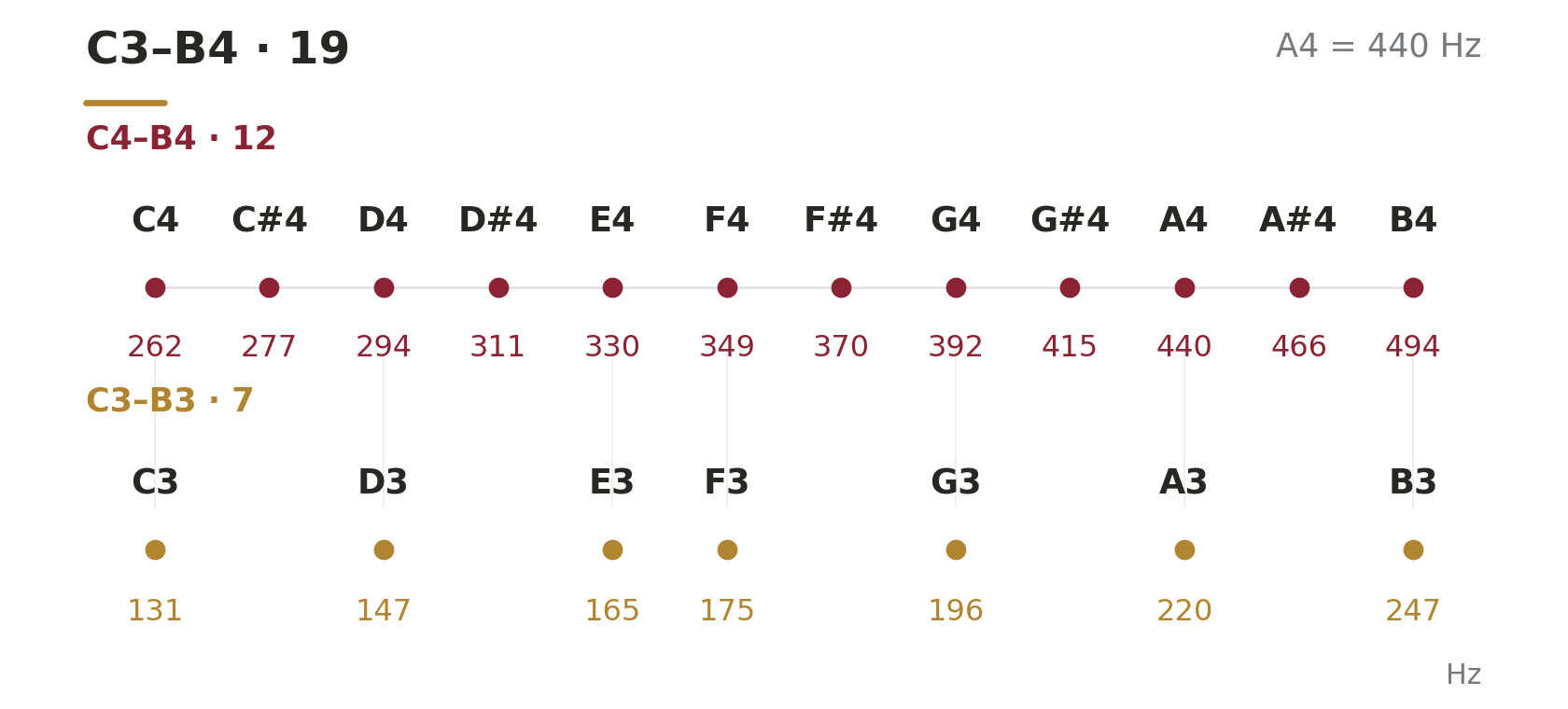
The graph shows theoretical reference pitches, not measurements of the supplied bowls or a continuous spectrum. The empty positions in octave 3 indicate notes not included in the kit.
In the chromatic fourth octave, neighbouring notes are one semitone apart (100 cents). Equal temperament uses a constant frequency ratio of approximately 1.05946 per step (+5.95%), rather than a fixed difference in hertz.
Return to a lower note as a foundation, then answer it with a short phrase in the upper register. Compare octave pairs, move upwards by semitones, or explore contrasting intervals. The five additional chromatic notes also let you compare major and minor colours, such as C–E–G and C–D#–G, with D# corresponding to E-flat in equal temperament.
You do not need to sound all 19 bowls together. Start with a small group and leave room for the resonances to develop. Each bowl has several partials, so a shared note label is not enough to predict how a combination will sound.
HSB selects bowls by their fundamental frequency, with a standard tolerance of less than 3% from the target. The graph is not a promise of exact tuning. If close matching matters, share your reference pitch and the measured frequencies of your existing instruments before selection. A quality-control video with frequency readings is available on request. See our quality-control process.
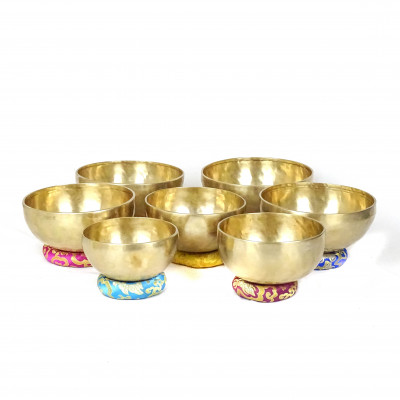
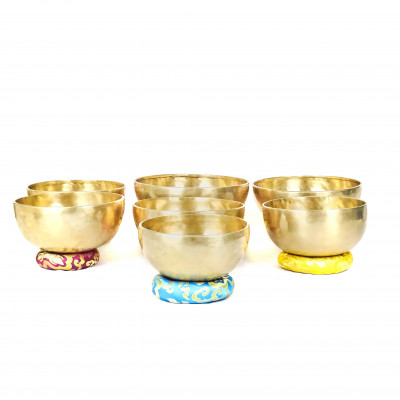
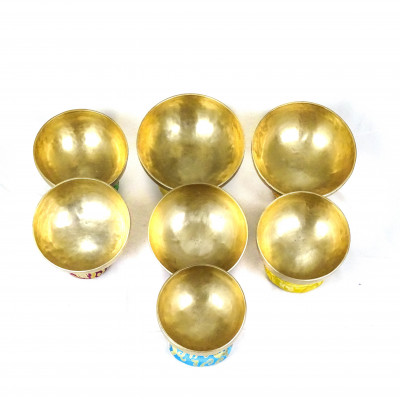
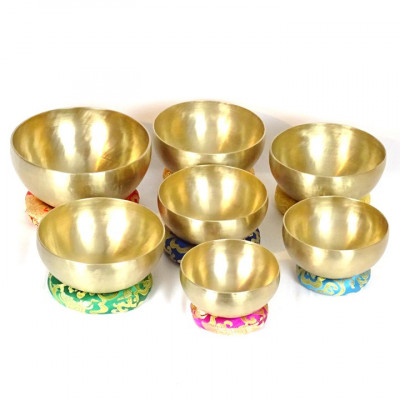
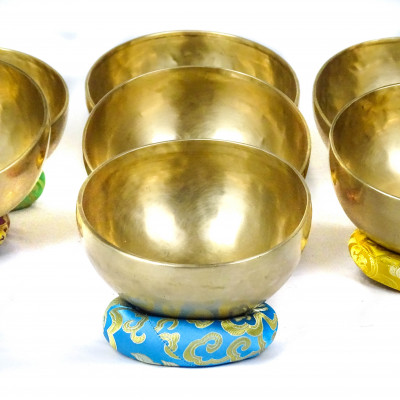
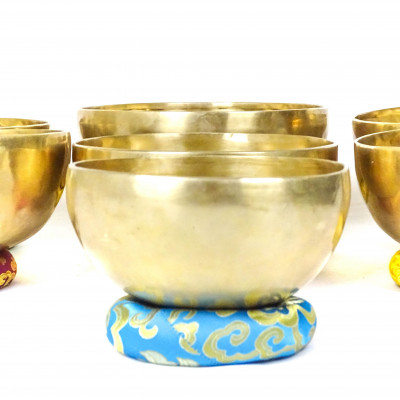
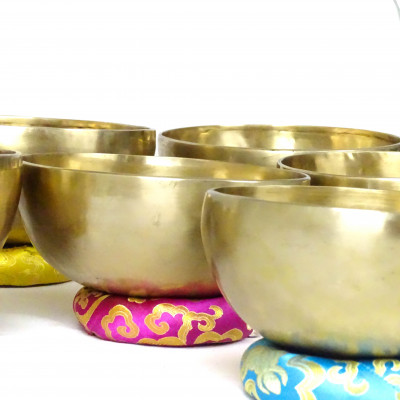
19 singing bowls handcrafted in Nepal, with a natural golden finish. Indicative combined bowl weight: 16.7–17.7 kg. Actual weight, dimensions, surface and timbre vary. Photos showing the seven-bowl set illustrate the third-octave component of this kit. Cushions, mallets and other accessories are sold separately.

Data sheet
Specific References