


How Large & Giant Himalayan Singing Bowls Are Made in Nepal | Traditional Hand-Hammered Process
.jpg "How Large & Giant Himalayan Singing Bowls Are Made in Nepal | Traditional Hand-Hammered Process")
Discover the detailed traditional hand-hammered process behind Nepal’s large and giant Himalayan singing bowls, including alloy preparation, forging, and acoustic fine-tuning.
How Large and Giant Himalayan Singing Bowls Are Made in Nepal
A Detailed Look at the Traditional Hand-Hammered Manufacturing Process
Large and giant Himalayan singing bowls are among the most technically demanding instruments produced in Nepal. While the traditional forging method remains consistent across sizes, manufacturing large and floor-size bowls—especially giant pieces—introduces significantly greater material mass, acoustic sensitivity, and structural risk.
Unlike small meditation bowls, oversized and giant singing bowls require thicker alloy blanks, extended heating cycles, coordinated multi-artisan hammering, and advanced acoustic evaluation. Each stage must be executed with precision to ensure both structural integrity and balanced resonance.
This article explains the complete production process of large and giant hand-hammered singing bowls, with particular attention to the technical differences that distinguish them from smaller bowls.
For a visual overview of HSB’s core process, see how HSB singing bowls are made.
1. Alloy Composition and Metal Preparation
The manufacturing process begins with alloy formulation.
Traditional Nepali singing bowls are made primarily from bronze composed of:
- Approximately 80% copper
- Around 20% tin
- Minor traces of iron, zinc, lead, silver, and gold
This blend is often referred to as the seven-metal singing bowls composition in Himalayan tradition.
Melting and Homogenization
The metals are placed in a high-temperature furnace and melted until fully liquefied. Proper homogenization is critical, as uneven melting can create density inconsistencies that later affect vibration behavior.
Once the alloy reaches the required temperature, it is poured into circular molds to form thick, solid metal discs, commonly called gullis.
For large and giant Himalayan singing bowls (40 cm and above, especially floor-size pieces exceeding 60–70 cm), the starting discs must be significantly thicker and heavier than those used for small bowls. The mass of the blank directly influences:
- Wall strength
- Structural stability
- Depth of tone
- Sustain duration
The larger the intended bowl, particularly in the case of giant singing bowls, the more critical the initial alloy volume becomes.
2. Cutting, Stacking, and Thermal Conditioning
To produce one large or giant singing bowl, three to five metal sheets are cut and stacked together.
- It accelerates early-stage shaping
- It allows consistent deformation across multiple layers
The stacked discs are heated to a red-hot state. At this temperature, the bronze becomes malleable but still structurally cohesive.
This becomes even more critical when producing giant bowls, where improper heat control can weaken the structure or create stress points.
3. Coordinated Group Hammering
A team of four to seven artisans begins synchronized hammering, led by an experienced craftsman.
Forging cycle: Heat → Hammer → Reheat → Hammer
For large and especially giant Himalayan singing bowls, thicker bronze requires deeper, controlled strikes. Poor distribution can lead to:
- Thin spots
- Warping
- Stress fractures
For giant singing bowls, this process can take multiple days.
4. Separation and Individual Forming
After initial shaping, sheets are separated and refined individually.
- Outer diameter
- Wall height
- Rim symmetry
- Curvature gradient
- Thickness distribution
Precision is especially critical in giant hand-hammered singing bowls, where small inconsistencies affect sound quality.
5. Rim Formation and Base Engineering
The rim is leveled to ensure smooth playing and even vibration.
The base of large and giant singing bowls must balance:
- Stability
- Sound projection
- Resonance transfer
6. Surface Finishing and Textural Refinement
The bowl is filed, scraped, and smoothed.
High-quality large and giant Himalayan singing bowls retain hammer marks, indicating authentic craftsmanship.
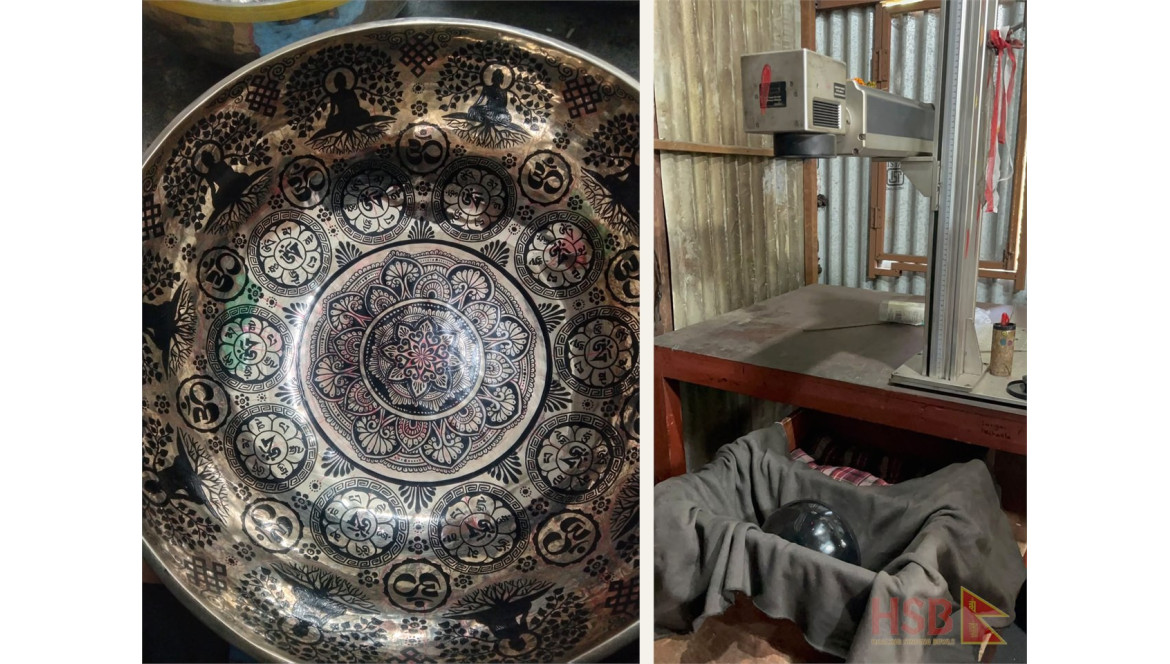
7. Decorative Engraving (Optional)
- Mantras
- Sacred symbols
- Deity engravings
- Geometric patterns
These are often applied to large and giant Tibetan singing bowls without affecting sound.
8. Acoustic Testing and Fine Tuning
Each bowl is tested for:
- Fundamental tone
- Sustain
- Harmonics
- Clarity
Large and giant singing bowls produce deeper frequencies and require precise tuning. Many of these bowls are used for healing singing bowls applications in meditation and therapy.
9. Why Giant Singing Bowls Require Senior Artisans
Metal Control: Managing thick bronze requires precision.
Coordination: Teams must work in perfect rhythm.
Risk Management: Mistakes are costly with giant bowls.
Acoustic Judgment: Sound quality expectations are higher, especially for sound therapy purposes.
Conclusion
The production of large and giant Himalayan singing bowls in Nepal involves advanced craftsmanship, precision, and experience. From alloy preparation to acoustic tuning, each stage contributes to the superior quality, durability, and resonance that distinguish authentic hand-hammered bowls from mass-produced alternatives.
In Same Category
- Inside Kathmandu’s Singing Bowl Finishing Industry
- Do Singing Bowls Really Contain 7 Metals? The Truth Explained Simply
- How Size, Thickness, and Form Change the Sound of a Singing Bowl
- The Laser Revolution: How Machine Carving Is Quietly Replacing Nepal's Hand-Carved Singing Bowl Tradition
- Hand-Hammered Singing Bowls: The Step Machines Replaced





Comments
No comment at this time!
Leave your comment