


How to Determine the Note of a Singing Bowl

Learn how to identify a singing bowl's note with a tuner or spectrum analyser. HSB explains the fundamental, partials, octaves, A4 = 440 Hz, 432 Hz and common measurement errors.
Quick answer: to determine the note of a singing bowl, strike it gently, measure the most stable low-frequency peak with a tuner or spectrum-analyser app, and match that frequency to the nearest note using A4 = 440 Hz. Repeat the test several times because a handmade bowl produces several frequencies at once, not one perfectly pure tone.
At Healing Singing Bowls (HSB), note selection is performed after production in Kathmandu. Each bowl is listened to and checked individually before it is grouped with bowls of a similar note. This guide explains a practical version of that process that you can reproduce at home.
Why a singing bowl can show more than one note
A singing bowl is a vibrating metal shell. When it is struck or rubbed, different parts of the bowl move in different patterns, called vibration modes. The sound therefore contains several frequency peaks:
- The fundamental or principal low tone: usually the note used to classify the bowl.
- Higher partials: additional tones that create the bowl’s colour and complexity.
- Beating: a slow pulsing effect produced when two strong frequencies are close together.
The word “harmonics” is often used informally for all these higher tones. Strictly speaking, the partials of a hand-hammered bowl are not always exact whole-number multiples of the fundamental. This is one reason a simple tuner can jump between different readings.
What you need
- A quiet room with little background noise.
- A consistent mallet or striker.
- A chromatic tuner app for a quick note reading.
- Optionally, a spectrum-analyser app for seeing several frequency peaks.
- A soft ring cushion or an open palm that supports the bowl without damping it.
A tuner is usually sufficient if you only need the nearest musical note. A spectrum analyser is more useful when the tuner alternates between two notes or detects a higher partial instead of the lower tone.
Step-by-step: how to identify the note
1. Set the tuning reference
Use A4 = 440 Hz unless you have a specific reason to use another reference. It is the standard setting used by most tuners. Check the app settings before measuring; otherwise, two people can obtain different note labels from the same frequency.
2. Support the bowl lightly
Place the bowl on a soft ring cushion or hold it on a flat, open palm. Avoid gripping the wall and avoid placing it directly on a hard table, because both can shorten the sustain or change which partials dominate.
3. Strike the bowl consistently
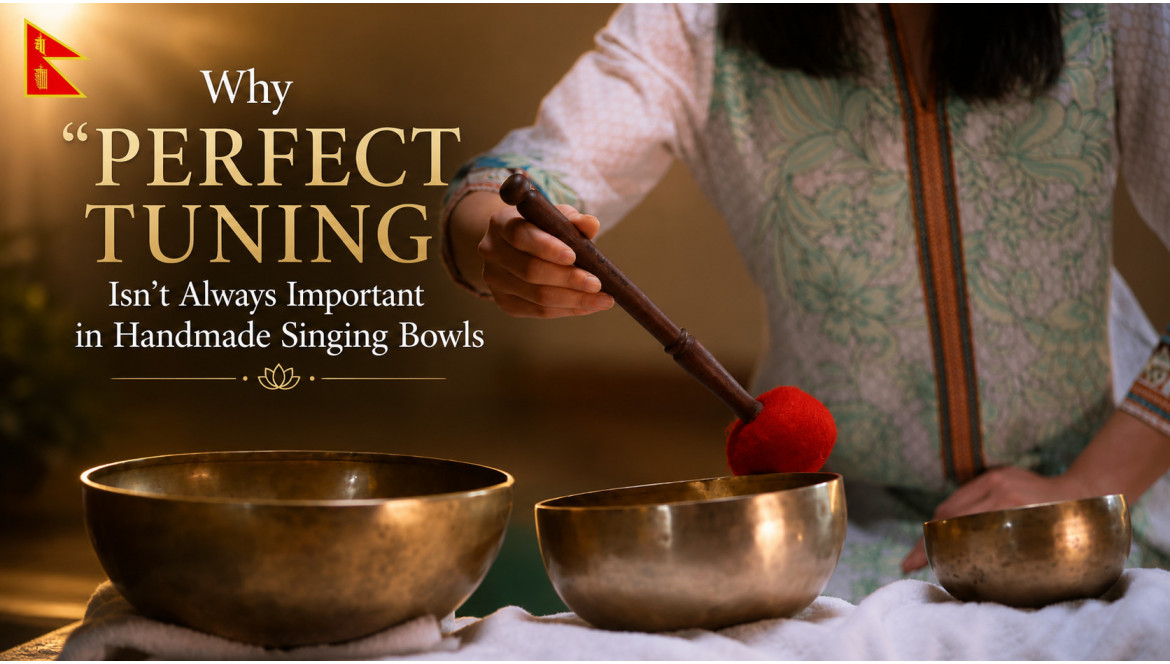
Strike the outside wall gently, close to the rim, using the same mallet and approximately the same force for every test. A soft felt mallet tends to emphasise lower components, while a hard wooden striker often makes higher partials more obvious.
4. Let the initial impact pass
The first fraction of a second contains impact noise and rapidly changing frequencies. Let the tone stabilise briefly, then read the note or frequency. Keep the phone at a consistent distance and do not move it while the bowl rings.
5. Find the lowest stable strong peak
With a tuner, note the reading that remains stable for the longest time. With a spectrum analyser, look for a strong low-frequency peak that persists as the sound decays. The tallest peak is not automatically the fundamental: depending on the bowl and mallet, a higher partial can be louder.
6. Repeat at least three times
Strike the bowl three to five times and record every stable result. If one reading is very different from the others, treat it as a likely partial or measurement error. Repetition is more reliable than relying on a single strike.
Frequency-to-note reference table
The table below uses equal temperament with A4 = 440 Hz. Match your measured frequency to the closest value. The octave matters: 130.81 Hz is C3, while 261.63 Hz is C4.
| Note | Octave 2 (Hz) | Octave 3 (Hz) | Octave 4 (Hz) |
|---|---|---|---|
| C | 65.41 | 130.81 | 261.63 |
| C♯ / D♭ | 69.30 | 138.59 | 277.18 |
| D | 73.42 | 146.83 | 293.66 |
| D♯ / E♭ | 77.78 | 155.56 | 311.13 |
| E | 82.41 | 164.81 | 329.63 |
| F | 87.31 | 174.61 | 349.23 |
| F♯ / G♭ | 92.50 | 185.00 | 369.99 |
| G | 98.00 | 196.00 | 392.00 |
| G♯ / A♭ | 103.83 | 207.65 | 415.30 |
| A | 110.00 | 220.00 | 440.00 |
| A♯ / B♭ | 116.54 | 233.08 | 466.16 |
| B | 123.47 | 246.94 | 493.88 |
A handmade bowl does not have to land exactly on one number in the table. If a bowl measures 133 Hz, for example, C3 remains the nearest note. For musical sets, the interval between the bowls and their behaviour together is often more useful than demanding an arbitrary whole-Hertz value.
Common measurement mistakes
- Choosing the loudest partial: use repeated readings and inspect the lower spectrum.
- Ignoring the octave: C3 and C4 share the same note name but C4 has twice the frequency.
- Changing mallets: different materials excite different parts of the sound.
- Measuring while circling the rim: rimming can emphasise a different mode. Use a clean strike for classification.
- Holding the wall: this damps the bowl and shortens the tone.
- Using a noisy room: speech, fans and traffic can become false peaks.
- Trusting one reading: always repeat the measurement.
What changes with 432 Hz tuning?
“432 Hz tuning” normally means that the reference note A4 is set to 432 Hz instead of 440 Hz. It does not mean that every bowl should produce a single frequency of 432 Hz. Changing the reference shifts the expected frequency of every note by about 1.8%.
A handmade bowl also produces multiple partials, so describing it simply as a “432 Hz bowl” or “528 Hz bowl” can be misleading. If you need a set classified against a particular reference, state the reference clearly when ordering. For a deeper explanation, read our guide Do Singing Bowls Have Exact Frequencies?
How HSB selects bowls by note
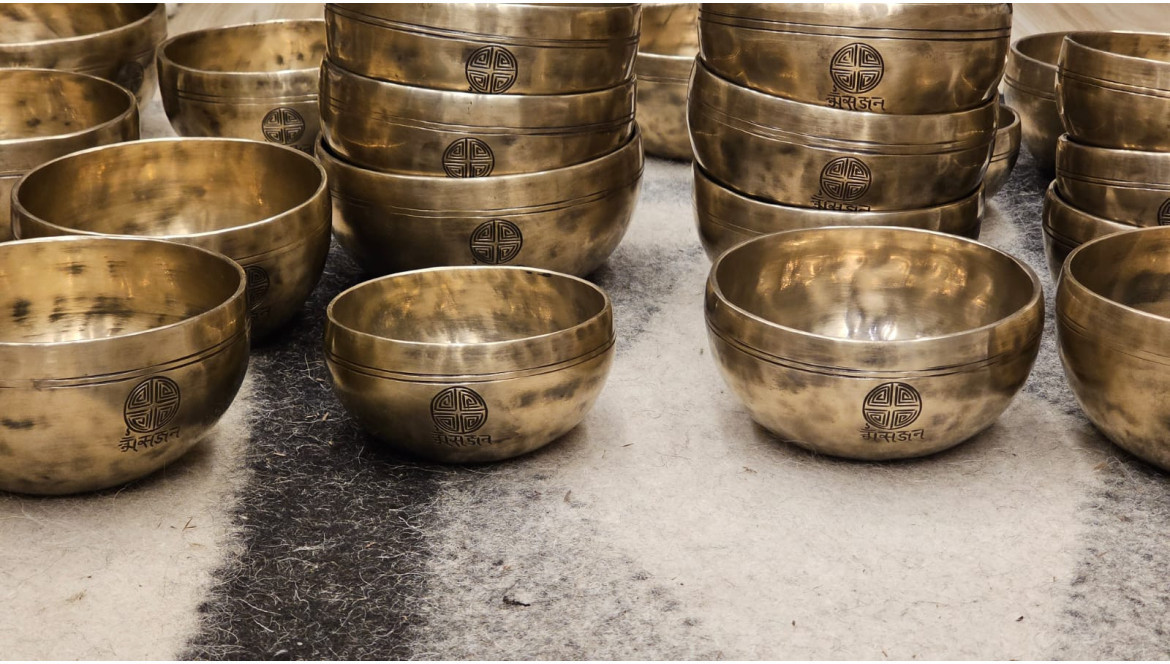
Because each handmade bowl becomes acoustically unique during hammering and finishing, its final note is confirmed after production rather than guaranteed only from diameter or weight. The HSB team checks the bowl in Kathmandu, identifies its stable principal tone, and then groups available stock by note and octave.
Size provides a useful tendency—larger bowls are generally lower and smaller bowls higher—but thickness, shape and individual hammering also matter. Two bowls of the same diameter can therefore produce different notes.
Note, frequency and therapeutic claims
A frequency measurement is an acoustic fact. Associations between individual notes and chakras belong to modern spiritual and wellness traditions; they are not a medical diagnosis or proof that one frequency treats a particular organ or condition. Choose notes for their musical relationship, playing purpose and the sound you or your clients prefer.
Choose a bowl or set by note
If you need one specific note, an octave-matched set, or help comparing several bowls, HSB can select from the stock available in Kathmandu. For a concrete octave-matched example, see our Small 5th Octave OM Singing Bowl Set. Every handmade bowl remains acoustically individual, so we confirm realistic tolerances before dispatch.
Explore singing bowls by musical note
Compare sets of singing bowls or contact the HSB team for a specific note and octave.
To compare available families before measuring, browse our singing bowl collection. A suitable singing bowl drumstick also helps produce a repeatable strike when checking the fundamental frequency.
Reviewed by the HSB team in Kathmandu. Educational information only; singing bowls are not a substitute for medical care.


Comments
No comment at this time!
Leave your comment