Combine Singing Bowls, Gongs & Tingshas in One Sound Healing Session | Practitioner Guide

person Posted By: Sajan Shakya list In: Singing bowls therapy On: comment Comment: 0 favorite Hit: 51
Combine Singing Bowls, Gongs & Tingshas in One Sound Healing Session | Practitioner Guide
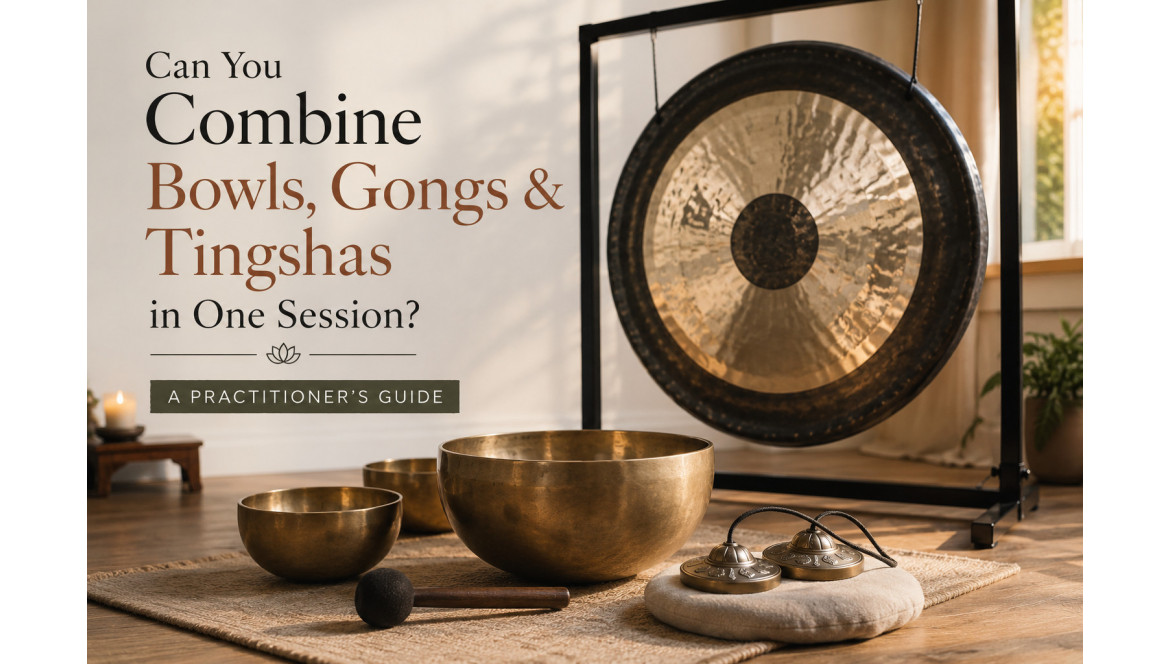
A complete practitioner guide on combining singing bowls, gongs, and tingshas in a structured sound healing session for full-spectrum therapeutic experiences.

Can You Combine Bowls, Gongs, and Tingshas in One Session? A Practitioner's Guide

If you have spent any time in the sound healing world, you have probably noticed that experienced practitioners rarely use just one instrument.

Walk into a professional sound bath and you will likely find singing bowls arranged around the room, one or more large gongs standing at the front, and a small pair of tingshas resting quietly nearby, ready to open and close the space.

This is not accidental. It is intentional design.

Each of these instruments does something different to the sound field, the body, and the nervous system. When combined thoughtfully, they create what many practitioners call a full-spectrum session — one that takes people through a complete arc of opening, deep immersion, and gentle return.

In this guide, you will learn:

  • What role each instrument plays in a session
  • How to choose the right instruments before you even begin
  • How to structure a session that combines all three
  • Common mistakes practitioners make and how to avoid them
  • What the research actually says and what it does not
  • Safety considerations and who to be cautious with
  • How to adapt the combination for different session types

Why Combine These Three Instruments?

Each instrument occupies a different sonic and energetic space. Together, they cover a range that no single instrument can achieve alone.

  • Singing bowls provide sustained harmonic tones in the low to mid frequency range, creating a stable, grounding sound field that supports nervous system relaxation
  • Gongs produce broad, powerful waves of vibration that penetrate deeply, creating a sense of expansion and full-body immersion
  • Tingshas cut through the density of bowls and gongs with a high, bright, focused tone, perfect for marking openings, transitions, and closure

Think of it as a conversation between three very different voices. The bowls hold the space with warmth. The gong takes people deeper than they might go alone. The tingshas bring them back with clarity and presence.

Done with care and intention, this combination creates a session with a clear beginning, a profound middle, and a grounded, conscious ending.

The Role of Each Instrument

Singing Bowls

Singing bowls are the foundation of most combined sessions. Their sustained harmonic overtones:

  • Promote deep meditation and a sense of safety
  • Support nervous system down-regulation, shifting the body toward rest and repair
  • Create a stable tonal field that other instruments can be layered on top of
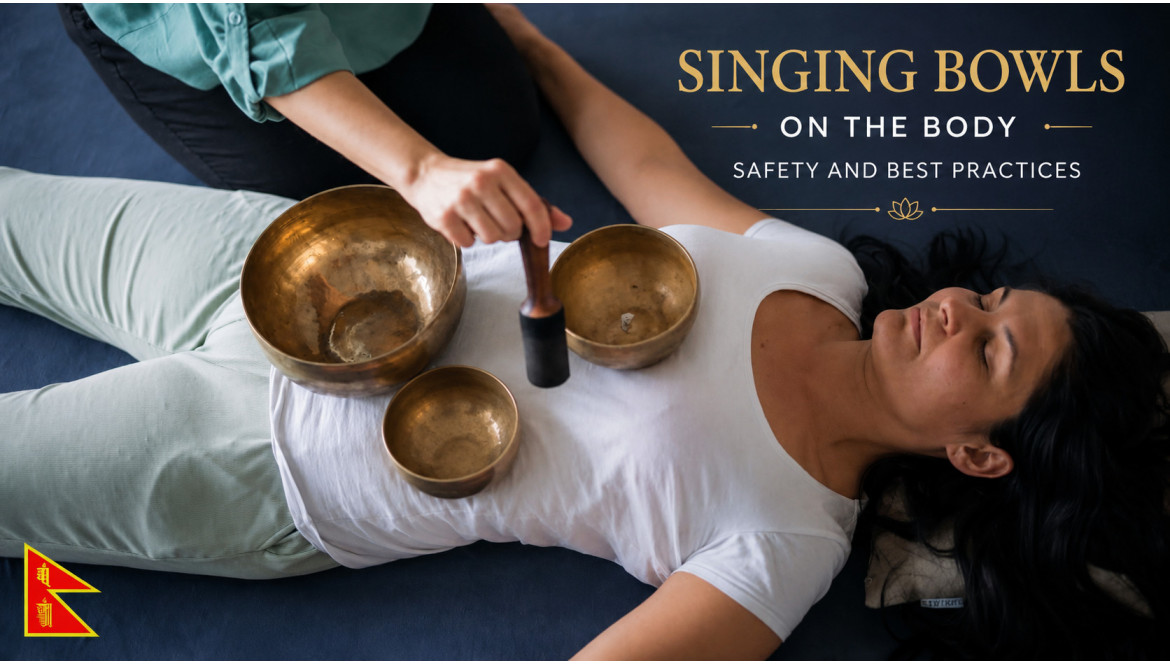
  • In one-to-one sessions, can be placed on or near the body for direct vibroacoustic effects

Gongs

The gong is the most powerful instrument in this combination. Its broad-spectrum vibration:

  • Creates deep, full-body clearing and a sense of expanded awareness
  • Penetrates further into the body's systems than bowls alone
  • Produces complex, evolving soundscapes that shift moment to moment
  • Needs to be introduced gradually, as a sudden loud gong strike can overwhelm rather than heal

Tingshas

Tingshas are small but their role is significant. Their sharp, high-frequency tone — often above 2000 Hz — does something neither bowls nor gongs can do as cleanly:

  • Cuts through density and heaviness in the sound field
  • Signals clear transitions, from ordinary space into sacred space, or from deep immersion back to waking awareness
  • Marks the beginning and end of practices with a tone that is impossible to ignore
  • Originates in Tibetan Buddhist ritual, where they were used to invoke presence and clear the environment

Choosing Instruments for Combined Sessions

Before you think about session structure, you need to think about instrument selection. The instruments you choose determine the quality, depth, and coherence of the sound field you create.

Singing Bowls: Build Around a Large Grounding Bowl

Start with a large grounding bowl as your foundation. A bowl in the 8 to 12 inch range produces a deep, low fundamental tone that settles the nervous system quickly and gives your sound field a stable base to build from.

Layer on a mid-size harmonic bowl in the 5 to 7 inch range. This adds brightness, overtone richness, and movement above the grounding tone without competing with it.

A few things to keep in mind when selecting bowls for layering:

  • Pitch spacing matters. Bowls that are too close in pitch will create an unpleasant clashing effect when played together. Look for bowls at least a third apart in pitch, ideally a fourth or fifth, so their resonances blend naturally
  • Avoid poorly tuned bowls when layering. A single bowl with an unstable or harsh overtone can undermine the entire sound field. Every bowl you add needs to hold its tone cleanly and sustain well on its own before it earns a place in the combination
  • Test bowls together before committing. Strike both bowls and listen to how their tones interact. A good pairing feels expansive and harmonious. A poor pairing feels cluttered or tense

Gongs: Start with One Medium Gong

For practitioners new to combining instruments, one medium gong in the 24 to 32 inch range is the ideal starting point. It is large enough to fill a room and create a genuinely immersive field without being so powerful that it becomes difficult to control.

  • Smaller gongs (under 24 inches) — brighter, more defined tone with less low-frequency body; easier to control but create a narrower sound field
  • Medium gongs (24 to 32 inches) — balanced mix of presence, depth, and control; the sweet spot for most therapeutic and group settings
  • Large gongs (36 inches and above) — vast, room-filling field of vibration; require significant skill and sensitivity to use safely in a healing context

Symphonic or planetary gongs are the most widely used in therapeutic settings because of their rich, complex overtone structure. Start with one. Learn it deeply before adding more.

Tingshas: Prioritize Quality Over Everything Else

Not all tingshas are equal, and the difference between a high-quality pair and a cheap one is immediately audible. High-quality bronze tingshas produce a clean, clear, sustaining tone that rings out fully and fades gracefully. Low-quality tingshas often produce a dull, short, or slightly fuzzy tone that lacks presence and clarity.

When selecting tingshas:

  • Look for pairs made from high-quality bronze alloy with a smooth, even finish
  • Test them by striking and listening for a clean, sustained ring with no buzz or rattle
  • The two cymbals should match in tone — a mismatched pair will produce an unpleasant clash rather than a harmonious ring
  • Larger tingshas (around 2.5 to 3 inches) produce a deeper, more resonant tone; smaller ones produce a higher, brighter ring

How to Structure a Combined Session

Before Clients Arrive: Space Preparation

  • Strike the gong once, softly, to shift the room from ordinary to intentional space
  • Walk the room with tingshas, striking once in each corner and at doorways
  • Let each tone fully fade before moving to the next corner
  • This is a soft clearing, not a therapeutic crescendo

Opening the Session

  • Welcome participants and briefly explain what they will experience
  • Guide a short breath awareness before any intense sound begins
  • Open with either a few slow, spacious bowl strikes for a soft, warm container, or one or two clear tingsha strikes for a sharper, more defined opening
  • Both approaches work — choose based on your style and the sensitivity of your group

Initial Descent: Bowls Only

  • Begin with singing bowls alone
  • Use slow, deliberate strikes or gentle rimming to create a stable tonal field
  • Keep volume moderate and movement predictable
  • Allow the nervous system time to settle before introducing more complex sound
  • This phase is about creating safety and trust in the sonic container

Introducing the Gong

Once participants are visibly relaxed, bring the gong in slowly:

  • Start with very light strokes at the outer edge of the gong
  • Build volume gradually over several minutes, never suddenly
  • Create waves of sound rather than a constant wall
  • Alternate between gong-forward passages and quieter moments where the bowls come back into focus
  • Let sounds fully decay often — the silence between sounds is as important as the sounds themselves

The Main Body: Alternating Textures

Move through cycles of intensity and rest:

  • Gong-forward passages for deep clearing, energetic expansion, and full-body immersion
  • Bowl-forward passages for re-centering, warmth, and integration
  • Use tingshas sparingly here — only to mark a significant shift or clear heaviness after a particularly intense gong wave
  • One intentional tingsha strike followed by complete silence can be remarkably powerful mid-session

The Closing Arc

  • Gradually reduce the gong and let it retire from the soundscape completely
  • Return to soft bowls only, becoming quieter and more spacious with each minute
  • End the sounding with one or two clear tingsha strikes to signal closure and return
  • The contrast between the tingsha's brightness and the bowls' warmth creates a natural, felt sense of arrival back in the room

Integration and Aftercare

  • Allow at least two to three minutes of complete silence after the final sound
  • Guide gentle movement, slow stretching, feeling the floor, noticing the breath
  • Offer water and encourage people to move slowly
  • Let participants know it is completely normal to feel spacey, emotional, or deeply calm

A Concrete 60-Minute Session Example

Time What Happens
0–5 min Space clearing, soft gong strike, tingshas in corners, then silence
5–15 min Opening talk, breath awareness, gentle bowl work only
15–25 min Bowls continue, gong introduced softly and built gradually
25–40 min Alternating gong-forward and bowl-forward sections with decay and silence
40–50 min Gong retired, soft bowls only, becoming quieter and sparser
50–55 min Final silence, then gentle tingsha strikes to close
55–60 min Integration, movement, grounding, water

Common Mistakes When Combining Multiple Instruments

Introducing the gong too early

This is the most common mistake in combined sessions. If the gong arrives before participants have settled into the sound field, it can shock rather than open the nervous system. The gong should feel like a natural deepening, not a sudden intrusion. Wait until the room is genuinely quiet and still before you bring it in.

Using too many instruments at once

More instruments do not mean more healing. When too many sounds compete in the same space at the same time, the result is noise rather than resonance. Each instrument needs space to breathe and be heard. If you cannot clearly distinguish each voice in the room, you are using too many at once.

Filling silence unnecessarily

Silence is not empty. In a sound healing session, silence is where integration happens. Many practitioners feel uncomfortable with it and rush to fill it with sound. This is a mistake. Some of the most powerful moments in a session are the ones where nothing is being played and the room is simply holding what just happened.

Striking tingshas too often

Tingshas have impact precisely because they are used sparingly. Strike them too frequently and they lose their ability to signal anything meaningful. They become background noise rather than a moment of clarity. Reserve them for when they truly serve the session.

Overpowering bowls with the gong

The gong is the loudest instrument in the room by far. If it is played at full intensity while bowls are also being struck, the bowls disappear entirely. The result is a flat, one-dimensional sound field dominated by the gong. Keep the gong at a dynamic level that allows the bowls to still be felt and heard alongside it.

Not observing participant response

A session plan is a starting point, not a contract. Participants communicate constantly through their body language, breathing, and energy in the room. If someone appears tense, agitated, or overwhelmed, that is information. Adjust the intensity, slow down, or bring in the bowls to stabilize. The plan should always serve the people, never the other way around.

Treating every session the same

A group of experienced meditators and a group of first-time participants are two completely different rooms. The same session design will not serve both. Always assess who is in the room before you begin, and be willing to change direction entirely if the group needs something different from what you planned.

Playing Tips for Each Instrument in Combination

Singing Bowls

  • Strike with a soft mallet on the mid-wall for a warm, round tone
  • When layering under the gong, keep bowl patterns slower and more spacious so they float rather than compete
  • In one-to-one sessions, move bowls around or near the body slowly and deliberately

Gongs

  • Use softer mallets for most therapeutic work
  • Strike along the outer zones and explore dynamic range slowly
  • Avoid rapid, chaotic playing as this can be disorienting for sensitive nervous systems
  • Build and release waves rather than sustaining constant intensity

Tingshas

  • Hold by the cord just above the cymbals so they hang freely
  • Let one cymbal swing gently to touch the other's edge, which allows full natural resonance
  • Let each strike ring out completely before striking again
  • Strike at a respectful distance from participants' ears, as their high frequency is intense at close range
  • The silence after a tingsha strike is as important as the sound itself

What Does the Research Actually Say?

Most detailed protocols for combining bowls, gongs, and tingshas are practitioner-derived and tradition-based. The clinical research is more limited and mainly focuses on singing bowls alone.

What Is Evidence-Based

Research on Tibetan singing bowls is growing. A 2025 systematic review in Integrative Medicine Research examined 19 clinical studies including randomized controlled trials and reported:

  • Reduced anxiety, depression, distress, and fatigue
  • Improved sleep quality
  • Improved heart rate variability, indicating a shift toward parasympathetic activity

One randomized study comparing Tibetan bowl sessions to progressive muscle relaxation found that bowl sessions produced greater reductions in anxiety and better changes in HRV and brainwave activity.

The honest caveat: sample sizes in these studies are still relatively small and methodological quality varies. The evidence is promising but not yet definitive.

What Is Not Evidence-Based (But Widely Practiced)

To be transparent with your clients and students, these elements are tradition-based or practitioner-derived and not clinically tested:

  • The specific session arc — bowls first, gong second, tingshas at opening and closing — comes from practitioner teaching, not controlled trials
  • Chakra associations for specific bowls, gong zones, or tingsha tones
  • Claims that gongs clear karmic patterns or tingshas cut through negative energy — these are spiritual interpretations from Tibetan Buddhist and New Age frameworks
  • The use of solfeggio frequencies, color associations, or numerology in session design

This does not make these approaches invalid or without value. It simply means they belong to a different category of knowing — one that is experiential, traditional, and symbolic rather than empirically measured.

A practical way to frame this with clients: "Research suggests that singing bowl sessions can reduce anxiety and support relaxation. The way we structure today's session — beginning gently, building depth, and closing with clarity — is based on practitioner wisdom and tradition, designed to support your nervous system safely."

Designing Different Types of Combined Sessions

Gentle Restorative Sound Bath

  • More bowls, very gentle gong waves, minimal tingsha
  • Ideal for beginners, anxious clients, or restorative yoga settings
  • Tingshas only at opening and closing

Deep Cleansing and Expansion

  • More gong, bowls as stabilizers, tingshas at key turning points
  • Strong but progressively built gong work
  • Soft bowl-led landing arc at the close

One-to-One Therapeutic Session

  • Use bowls on or near the body for targeted vibroacoustic work
  • Gong opens the broader energetic field from a distance
  • Use tingshas very sparingly near the client — often only at the crown or feet to signal closure and support full return before standing

Safety: Who to Be Careful With

Combining these instruments is safe for most people. However, there are important considerations.

Be cautious with or seek specialist guidance for:

  • People with pacemakers, cochlear implants, or deep brain stimulators, as strong vibration may pose risks
  • Serious heart or vascular conditions
  • Pregnancy, especially the first trimester
  • Epilepsy or seizure history
  • Recent surgical sites or metal implants — avoid placing bowls directly over these areas

Extra care for:

  • People with severe anxiety, PTSD, or acute trauma, as intense gong work or sudden sound shifts can trigger dysregulation rather than relaxation
  • First-time participants — always start gentler than you think you need to and build trust before introducing gong intensity
  • Children and highly sensitive individuals — keep gong dynamics moderate and tingshas at a comfortable distance

A general principle: always invite clients to speak up or signal if they feel overwhelmed. The practitioner's role is to read the room and adjust, not to follow a fixed plan regardless of response.

Common Questions

Do I need all three instruments to run a good session?

No. Bowls alone can create a profound and complete experience. Adding gongs and tingshas adds range and structure, but only if you have the training and sensitivity to use them well. It is always better to use fewer instruments with great intention than many instruments without clarity.

Can tingshas be used during the session or only at the beginning and end?

They can be used mid-session, but sparingly. One intentional tingsha strike to mark a major shift, followed by complete silence, can be very powerful. Overusing them mid-session dilutes their impact and can disrupt the depth of the sound field.

What type of gong is best for combined sessions?

Symphonic or planetary gongs are the most commonly used in therapeutic settings. They produce a broad, complex sound field that responds well to gradual building. Start with whatever gong you have and focus on technique first.

Is this combination suitable for complete beginners to sound healing?

As a practitioner, yes — if you approach it with training and care. As a recipient, yes for most people, as long as the session is designed with gentleness, gradual building, and clear aftercare.

Conclusion

Combining singing bowls, gongs, and tingshas in one session is not just possible. When done with intention and skill, it is one of the most complete and powerful sound healing experiences you can offer.

Each instrument has a voice. Each voice has a purpose. The bowls hold the space. The gong opens the depths. The tingshas bring clarity and return.

The key is not to use all three because you have them. It is to use each one because it serves the moment, the person, and the arc of the session.

Start with the structure outlined here. Choose your instruments carefully. Learn the common mistakes before they happen in the room. Adapt everything to the people in front of you.

Let the session breathe. Leave room for silence.

And remember — the most powerful thing in any sound healing session is not the instruments. It is the intention behind the hands that play them.

Comments

No comment at this time!

Leave your comment

Sunday Monday Tuesday Wednesday Thursday Friday Saturday January February March April May June July August September October November December