


Om Mani Padme Hum: Meaning, Tradition & Singing Bowls

A clear, culturally respectful guide to Om Mani Padme Hum, its Buddhist context and its use on engraved singing bowls made in Nepal.
Om Mani Padme Hum: Meaning, Tradition and Singing Bowls
Om Mani Padme Hum is the six-syllable mantra associated with Avalokiteshvara, known as Chenrezig in Tibetan Buddhism, the bodhisattva of compassion. It is recited, written and engraved throughout Tibet and the Himalayan region. Its importance comes from a living religious tradition, not from a claim that the syllables are a medically proven frequency.
What Does Om Mani Padme Hum Mean?
The phrase is often translated as “the jewel in the lotus,” but that short formula does not capture every traditional explanation. In a teaching published by the Office of the Dalai Lama, mani is connected with the jewel of method or bodhicitta, padme with the lotus of wisdom, and hum with their inseparable union. Interpretations vary by teacher and lineage, so the mantra is better understood through its Buddhist context than through a single literal translation.
Avalokiteshvara and the Practice of Compassion
Avalokiteshvara represents compassion in Mahayana Buddhism. Recitation may form part of prayer, meditation, visualization and community ritual. Practitioners understand its effects within that spiritual framework. HSB respects those beliefs without presenting them as clinical outcomes.
Pronunciation varies across Sanskrit, Tibetan and local traditions. Common forms include “Om Mani Padme Hum” and the Tibetan-influenced “Om Mani Peme Hung.” A sincere practice does not depend on forcing one commercial pronunciation.
Why the Mantra Is Engraved on Singing Bowls
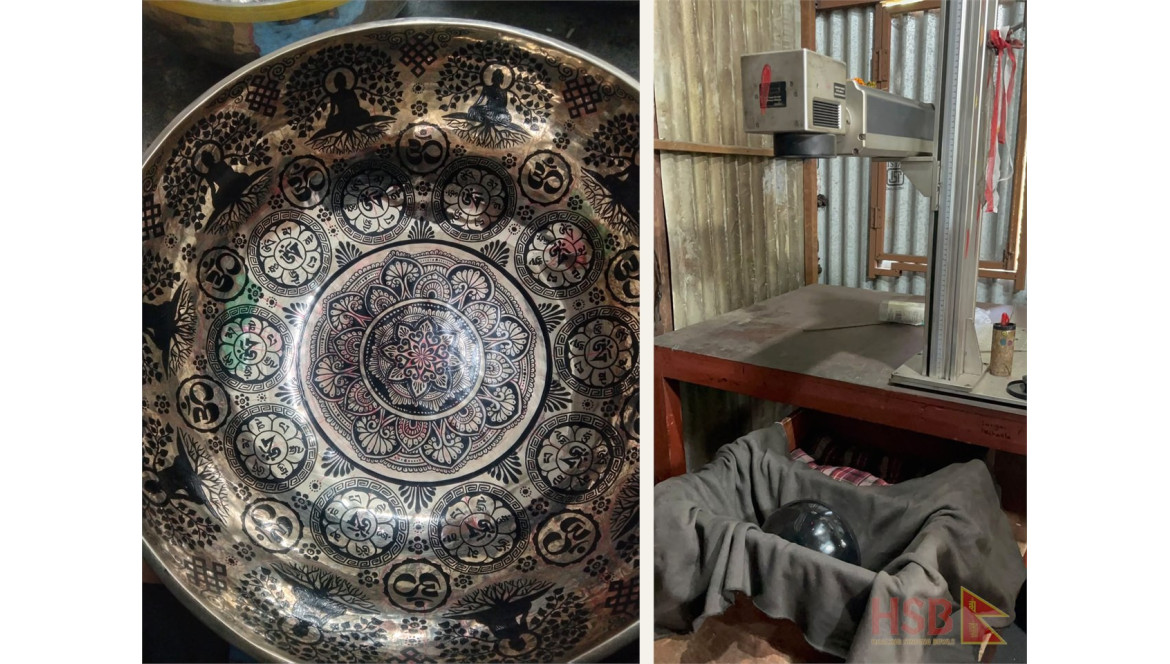
In Nepal, artisans engrave the mantra on metal objects, prayer wheels, stones and singing bowls. On a bowl, the inscription gives the object artistic and devotional meaning. It does not automatically change the bowl’s acoustic quality or turn it into a medical device.
HSB offers finely engraved singing bowls and can review certain projects through its customized singing bowl service. Symbols and sacred text should be placed with care, kept legible and described accurately.
Sound, Meditation and Responsible Claims
A singing bowl can provide a sustained tone that some people use as an attention cue before or after mantra recitation. The experience may feel calming, neutral or uncomfortable depending on volume, distance, setting and the listener. It is reasonable to speak about meditation, listening and personal practice; it is not reasonable to promise that an engraved mantra cures disease, clears organs or emits one universal healing frequency.
Choosing an Engraved Bowl
- Choose the bowl first for size, sound and intended use.
- Check that the mantra or symbol is represented respectfully and clearly.
- Remember that engraving and patina are visual finishes, not guarantees of better sound.
- For a personal logo, name or specific placement, ask HSB to review technical feasibility before production.
Explore the wider HSB singing bowl collection if sound and size are your first priorities.
Sources and Further Reading
For traditional explanations, see the Office of His Holiness the Dalai Lama on Avalokiteshvara and the meaning of the mantra, and the Avalokiteshvara introduction published by Lotsawa House. These sources describe religious teachings; they are not clinical evidence.
This article provides cultural and product information, not medical advice.


Comments
No comment at this time!
Leave your comment