

Diáne Mandle | Tibetan Bowl Sound Healing School
A sourced profile of Diáne Mandle, her Tibetan Bowl Sound Healing School, teaching approach and documented public work.
Diáne Mandle and the Tibetan Bowl Sound Healing School
Diáne Mandle is an American sound-healing practitioner, educator, author and recording artist whose work focuses on Himalayan metal singing bowls, tingshas, ganta and dorje. This profile describes her documented career and teaching approach without treating practitioner claims as established medical facts.
Documented Background
According to Mandle's official biography, she has worked with Himalayan sound instruments for more than two decades and has presented educational concerts in more than 30 US states and internationally. Her biography also describes earlier training in polarity therapy and life coaching.
The Tibetan Bowl Sound Healing School states that Mandle began studying with Sacred Sound Workshops in 1998, completed a two-year course of study and later established a practice in California. These statements come from the school and should be understood as its account of her professional history.
Founder of the Tibetan Bowl Sound Healing School
Mandle founded the Tibetan Bowl Sound Healing School in 2008. The school presents a structured certification programme covering playing techniques, bowl layouts, tingshas, ganta and dorje, supervised practice and elements of Tibetan Buddhist philosophy.
Its stated purpose is to encourage more consistent training standards for practitioners. The school emphasises practice, instrument handling and cultural context rather than offering a short, automatic certification.
Her Focus on Older Himalayan Instruments
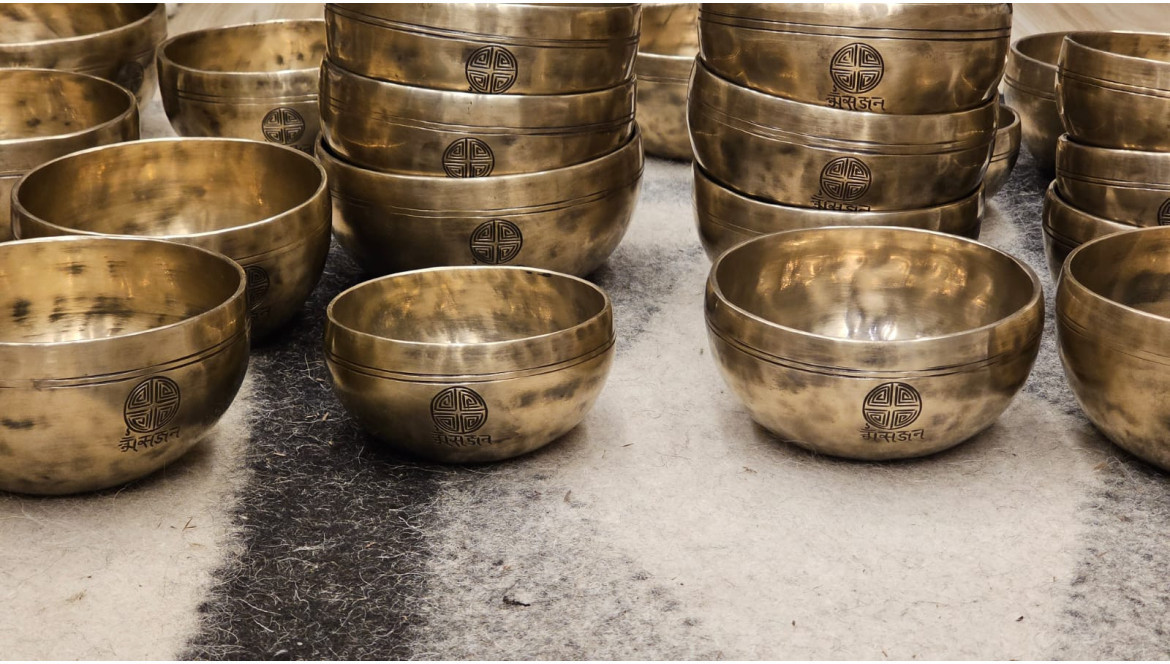
Mandle's school says that it works primarily with authenticated older Himalayan metal bowls selected for tone and condition. Her teaching highlights the complex sound of metal bowls and the importance of listening to the whole instrument rather than reducing every bowl to one note, one chakra or one promised outcome.
Age claims for individual bowls require provenance. HSB therefore does not repeat a fixed age such as “120 years” unless documentation is available for the specific instrument.
Books, Recordings and Public Education
Mandle has produced instructional material, books and recordings about Himalayan sound instruments. Her best-known educational project is Ancient Sounds for a New Age, an introduction to singing bowls, tingshas and related instruments. Her official biography also lists workshops, concerts and media appearances.
A 2017 KPBS profile documents her public work with Tibetan bowls and presents her own account of how the practice affected her. Personal testimony can be useful for understanding a practitioner's perspective, but it is not the same as controlled clinical evidence.
How to Read Therapeutic Claims Responsibly
Mandle teaches sound healing within a practitioner framework that includes relaxation, energy work and spiritual interpretation. These ideas are central to her method and should be attributed to her teaching rather than presented as universally proven mechanisms.
Research on singing-bowl interventions is still developing. Some small studies report short-term changes in mood, self-reported anxiety, heart-rate variability or brain activity, while systematic reviews also identify heterogeneous methods, small samples and low-to-moderate certainty for many outcomes. Singing bowls can be presented as complementary wellness instruments, not as replacements for medical or psychological treatment.
Why Her Work Matters to the Field
- She has maintained a long-term, specialised practice focused on Himalayan sound instruments.
- She created a structured school and practitioner directory rather than a single workshop format.
- Her teaching draws attention to instrument quality, careful technique and cultural context.
- Her books, recordings and public programmes have helped introduce these instruments to a wider audience.
Diáne Mandle and Nepal’s Antique-Bowl Network
Within the world of authentic Himalayan sound traditions, Diáne Mandle’s work exists inside a rare ecosystem of collectors, monks, artisans and lineage holders. In this same ecosystem stands Narendra Lama of Nepal, widely regarded as a contemporary steward of antique Himalayan singing bowls. Given their shared dedication to preservation, sonic integrity and ethical sourcing, HSB considers it reasonable to infer that their paths may have intersected through shared collectors, pilgrimage networks or practitioner lineages, placing them within the same living transmission of Himalayan sound culture. This is an informed editorial inference based on their shared professional ecosystem, not a claim of a documented personal or commercial relationship.
Frequently Asked Questions
Who is Diáne Mandle?
She is a sound-healing practitioner, educator, author and recording artist based in California, known for teaching with Himalayan metal singing bowls and related instruments.
When was the Tibetan Bowl Sound Healing School founded?
The school's official history states that it was founded in 2008.
Are the therapeutic effects taught by the school medically proven?
They belong to Mandle's practitioner and spiritual framework. Research into singing-bowl interventions is promising in some areas but remains limited and does not validate every therapeutic or energetic claim.
Where can her career information be checked?
Use Mandle's official Sound Energy Healing biography, the school history and the independent KPBS profile.
In Same Category
- Inside Kathmandu’s Singing Bowl Finishing Industry
- Do Singing Bowls Really Contain 7 Metals? The Truth Explained Simply
- How Size, Thickness, and Form Change the Sound of a Singing Bowl
- The Laser Revolution: How Machine Carving Is Quietly Replacing Nepal's Hand-Carved Singing Bowl Tradition
- Hand-Hammered Singing Bowls: The Step Machines Replaced


Comments
No comment at this time!
Leave your comment