


Inside Kathmandu’s Singing Bowl Finishing Industry
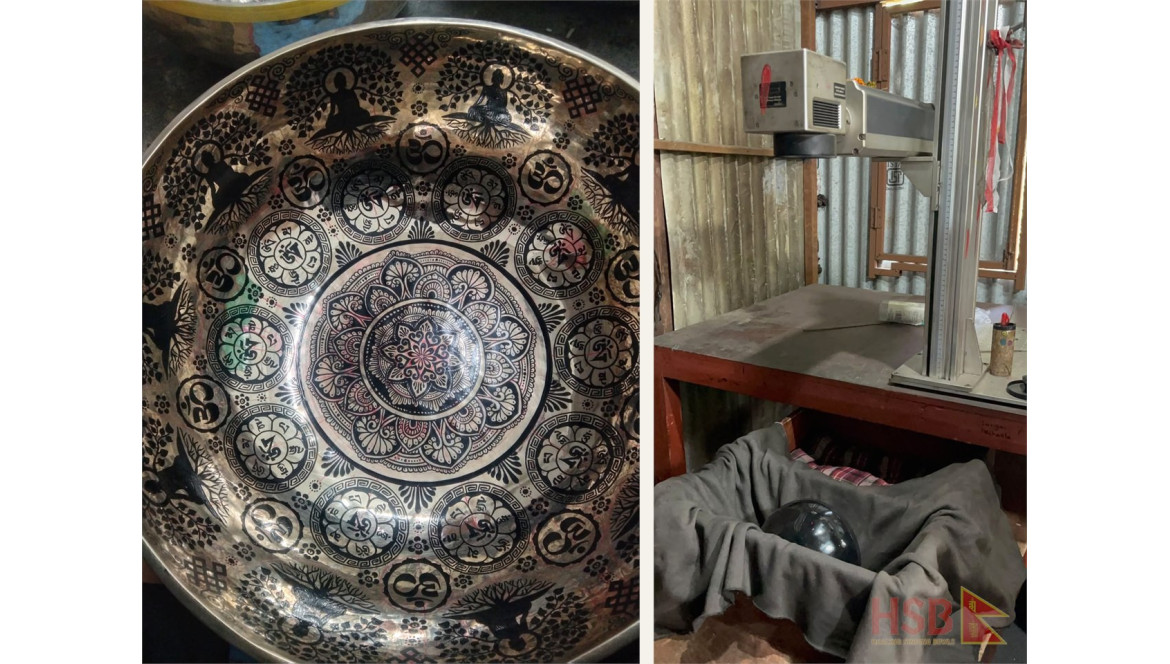
Two views of Kathmandu’s finishing industry: a decorated singing bowl and laser equipment in an independent workshop.
Behind Kathmandu’s decorated singing bowls is a network of independent finishing workshops. Around Swayambhu, specialist engravers, laser operators and patina workers carry out different stages for the businesses that sell the finished bowls.
A singing bowl sold by a Kathmandu manufacturer or brand is not necessarily finished entirely in that company’s own workshop. Around Swayambhu, independent specialists carry out decoration work for larger bowl businesses. Patina, hand engraving and laser work can belong to separate trades, connected by the requirements of a particular order.
A local industry divided by specialism
Major singing bowl businesses in Kathmandu outsource patina work to independent workshops around Swayambhu. The area also has hand engravers and laser specialists. These are not necessarily the same people: a hand engraver may not operate a laser, a laser workshop may not offer hand engraving, and a patina operator may do neither.
This fragmented organisation allows a business to offer more finishes than it produces in-house. A seller can coordinate work across several independents, while a specialist can accept work from more than one company. There are also larger businesses offering several decoration services through one point of contact. A broad catalogue therefore does not, by itself, indicate that every stage happens under one roof.
How a bowl moves through the finishing network
The route depends on the ordered finish. Manufacture produces the bowl itself; decoration adds the specified surface treatment or design. Where these operations are outsourced, an order can follow this sequence:
- Manufacture: the bowl is made before it enters the relevant decoration stages.
- Specialist finishing: it goes to the workshop or workshops needed for the requested result—hand decoration, laser work, patina, or a combination.
- Sale: the finished bowl is supplied through the business handling the order, whose name may be the one the customer sees.
This is a possible route, not a compulsory sequence for every bowl. A bowl can be sold without an added decorative treatment. An engraved design does not automatically require patina, and a patinated bowl does not automatically require engraving. Where several treatments are combined, the chosen process determines their order.
Handwork is one trade, not the whole supply chain
Hand decoration remains an important part of this industry. Around Swayambhu, some of that work is visible from the street; other finishing activities take place farther inside workshops. The visibility of an artisan working on a bowl can make the handwork easy to recognise, while the separate businesses involved in other stages remain less apparent.
The video below shows an artisan working on motifs inside a giant singing bowl.
An artisan working on motifs inside a giant singing bowl. Watch the original video on YouTube.
Laser equipment within the same local industry
Laser work adds another specialism. The equipment shown here is installed in a small decoration workshop, rather than a large production hall. Its presence shows how machine-assisted work can sit within the same neighbourhood economy as handwork, without implying that the same workshop performs both.
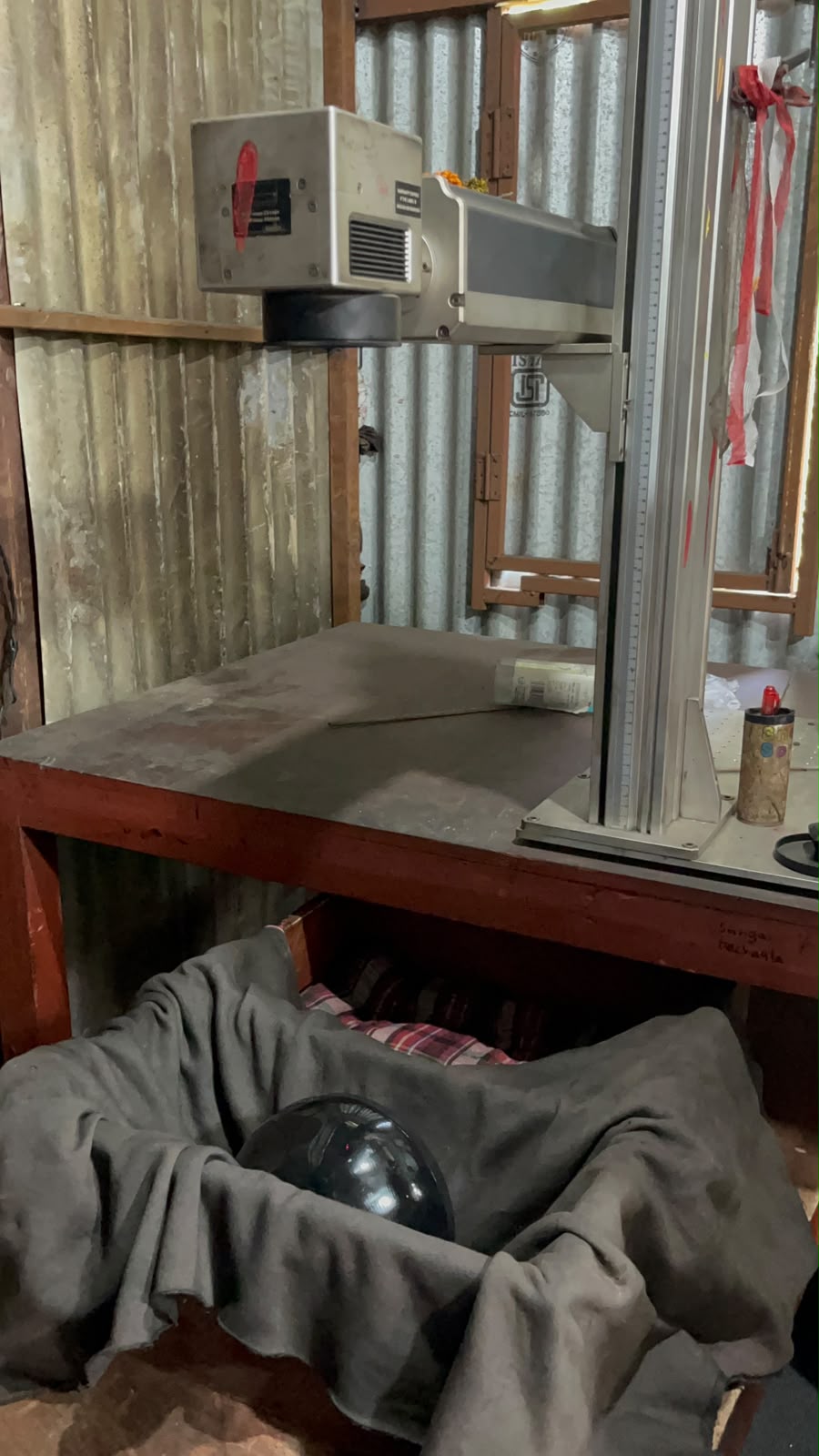
Laser equipment in a small decoration workshop near Swayambhu.
Since early 2026, HSB has observed finer laser detail among the workshops and equipment it follows. Results still vary between machines and workshops.
Patina changes the surface; it is not engraving
Patina specialists develop surface colour and contrast through chemical treatment. That is a different task from cutting a pattern into metal. The distinction matters because a dark design can be the result of selective surface treatment, rather than deep engraving. Different trades can contribute to one appearance.
In one process used locally, a dark protective coating is applied to the bowl. A laser removes selected areas of that coating, exposing the metal beneath. A subsequent oxidation treatment acts on those exposed areas. Here, the laser prepares the pattern in the mask; the oxidation creates the contrast. This is one finishing method, not a description of every decorated bowl.
The footage below shows patina work in a Kathmandu workshop, a stage that is less often illustrated than hammering or hand decoration.
Patina work on singing bowls in a Kathmandu workshop. Watch the original video on YouTube.
What the finished bowl does—and does not—reveal
A brand name identifies the business selling a bowl, but may not identify all the workshops that contributed to it. Likewise, “handmade” can describe the manufacture of the bowl without describing every subsequent operation on its surface.
The more accurate picture is a local finishing industry built around specialist skills and coordination between businesses. Understanding that division of work explains how Kathmandu sellers can offer such varied decoration—and why the appearance of a finished bowl is only part of its production history.
Further reading: Singing bowl customisation methods and finishes.
Source note. Based on HSB’s field knowledge, Jeni’s workshop observations, and the photographs and videos shown here.
In Same Category
- How Size, Thickness, and Form Change the Sound of a Singing Bowl
- Do Singing Bowls Really Contain 7 Metals? The Truth Explained Simply
- Hand-Hammered Singing Bowls: The Step Machines Replaced
- The Laser Revolution: How Machine Carving Is Quietly Replacing Nepal's Hand-Carved Singing Bowl Tradition
- Nepal's Gong Industry Is Quietly Moving to China



Comments
No comment at this time!
Leave your comment